Animals / Mammal
Harbor seal
Phoca vitulina · Phocidae
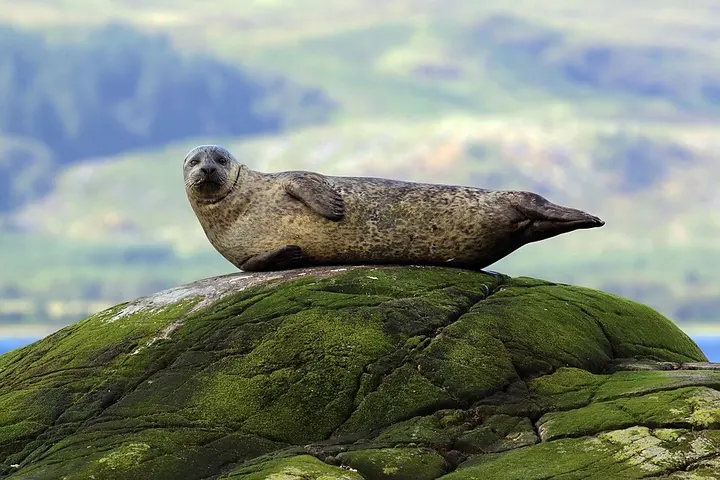
The harbor seal, also known as the common seal, is a true seal found along temperate and Arctic marine coastlines of the Northern Hemisphere. The most widely distributed species of pinniped, they are found in coastal waters of the northern Atlantic and Pacific oceans, Baltic and North seas.
Harbor seals are brown, silvery white, tan, or grey, with distinctive V-shaped nostrils. An adult can attain a length of 1.85 m (6.1 ft) and weigh up to 168 kg (370 lb). Blubber under the seal's skin helps to maintain body temperature. Females outlive males (30–35 years versus 20–25 years). Harbor seals stick to familiar resting spots or haulout sites, generally rocky areas (although ice, sand, and mud may also be used) where they are protected from adverse weather conditions and predation, near a foraging area. Males may fight over mates under water and on land. Females bear a single pup after a nine-month gestation, which they care for alone. Pups can weigh up to 16 kg (35 lb) and are able to swim and dive within hours of birth.
Appearance
Individual harbor seals possess a unique pattern of spots, either dark on a light background or light on a dark. They vary in colour from brownish black to tan or grey; underparts are generally lighter. The body and flippers are short, heads are rounded. Nostrils appear distinctively V-shaped. As with other true seals, there is no pinna (ear flap). An ear canal may be visible behind the eye.
Where the Harbor seal lives
Recorded in Netherlands, United States of America, France, Denmark, United Kingdom, Sweden, Canada, Norway, Germany and Ireland (Europe and North America).
Most records fall in Manche, Maine, Noord-Holland, California, Somme and Zeeland.
See the Harbor seal’s range on the globe
Conservation status
Least concern (LC). Not at risk: it is doing well in the wild. Categories are the IUCN Red List as republished by GBIF.
Sources
The range is a density of 339,427 georeferenced GBIF records, shown on the continents where it is mainly recorded, not an expert-drawn map. Description from Wikipedia.