Animals / Mammal
Hammer-headed bat
Hypsignathus monstrosus · Pteropodidae
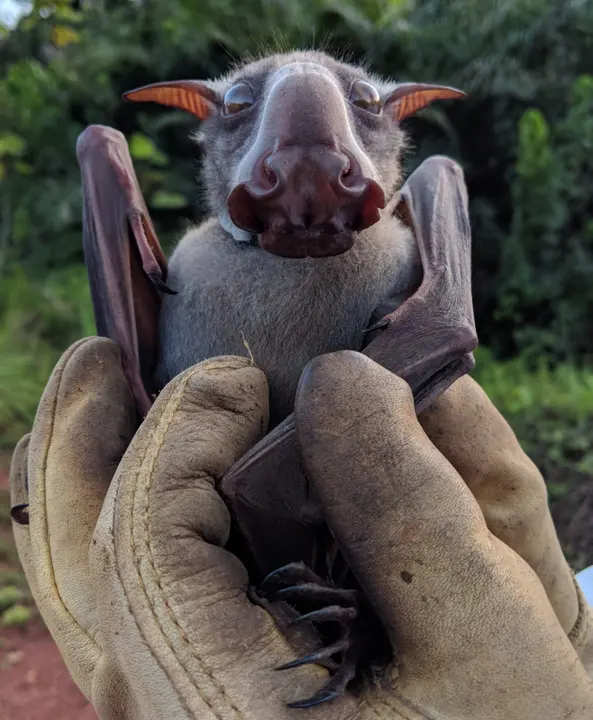
The hammer-headed bat, also known as hammer-headed fruit bat, big-lipped bat, and hammerhead bat, is a megabat widely distributed in West and Central Africa. It is the only member of the genus Hypsignathus, which is part of the tribe Epomophorini along with four other genera. It is the largest bat in continental Africa, with wingspans approaching 1 m (3.3 ft), and males are almost twice as heavy as females.
Males and females also greatly differ in appearance, making it the most sexually dimorphic bat species in the world. These differences include several adaptations that help males produce and amplify their voice; the males' larynges (vocal cords) are about three times as large as those of females, and they have large resonating chambers on their faces. Females appear more like a typical megabat, with fox-like faces. The hammer-headed bat is frugivorous, consuming a variety of fruit such as figs, bananas, and mangoes, though a few instances of carnivory have been noted. Females tend to travel a consistent route to find predictable fruit supplies, whereas males travel more to find the highest quality fruit. It forages at night, sleeping during the day in tree roosts.
Appearance
The hammer-headed bat is the largest bat in mainland Africa. Males have wingspans up to 90.1 cm (2.96 ft), and all individuals have forearm lengths exceeding 112 mm (4.4 in). It has pronounced sexual dimorphism, more so than any other bat species in the world, with males up to twice as heavy as females. The average weight of males is 420 g (15 oz), compared to 234 g (8.3 oz) for females.
Behaviour
During the day, the hammer-headed bat roosts in trees, typically 20–30 m (66–98 ft) above the ground in the forest canopy. Various trees are used for roosting, with no preference for a particular species. It has low fidelity to its roost and will move to a new roost after 5–9 days. It relies on camouflage to hide from predators. It displays a mix of solitary and social behaviour.
Habitat
The hammer-headed bat is a lowland species, always occurring below 1,800 m (5,900 ft) above sea level. Most records of this species occur in rainforest habitat, including lowland rainforest, swamp forest, riverine forests, and mosaics of forest and grassland. While it has been documented in savanna habitats, these records are rare, and it has been speculated that these individuals are vagrants.
Life cycle
Little is known about reproduction in hammer-headed bats. In some populations, breeding is thought to take place semi-annually during the dry seasons. The timing of the dry season varies depending on the locality, but in general the first breeding season is from June to August and the second is from December to February.
Where the Hammer-headed bat lives
Recorded in Dem. Rep. Congo, Côte d'Ivoire, Ghana, Gabon, Uganda, Cameroon, Eq. Guinea, Central African Rep., Burkina Faso, Congo, Kenya, Sierra Leone and Liberia (Africa).
Most records fall in Ogooué-Ivindo, Orientale, Lagunes, Équateur, Western and Haut-Sassandra.
See the Hammer-headed bat’s range on the globe
Conservation status
Least concern (LC). Not at risk: it is doing well in the wild. Categories are the IUCN Red List as republished by GBIF.
Sources
The range is a density of 426 georeferenced GBIF records, shown on the continents where it is mainly recorded, not an expert-drawn map. Description from Wikipedia.