Animals / Mammal
Hamadryas baboon
Papio hamadryas · Cercopithecidae
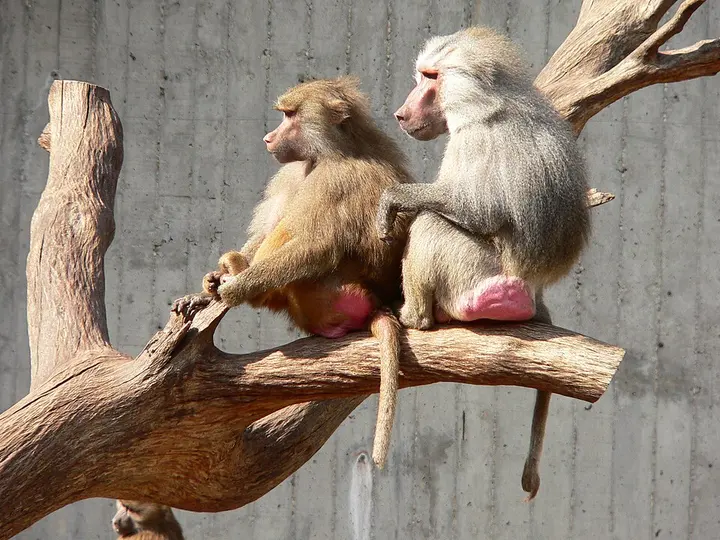
The hamadryas baboon is a species of baboon within the Old World monkey family. It is the northernmost of all the baboons, being native to the Horn of Africa and the southwestern region of the Arabian Peninsula. These regions provide habitats with the advantage for this species of fewer natural predators than central or southern Africa where other baboons reside.
The hamadryas baboon was a sacred animal to the ancient Egyptians and appears in various roles in ancient Egyptian religion, hence its alternative name of sacred baboon.
Appearance
The hamadryas baboon shows differences in coloration among adults with males having a pronounced silver-white mane and mantle, which they develop at around the age of ten years, while the females are capeless and brown all over and have reddish to dark brown faces. They are also sexually dimorphic in size, and males are nearly twice as large as females.
Behaviour
The hamadryas baboon's range extends from the Red Sea in Eritrea to Ethiopia, Djibouti and Somalia. It is also native to the Sarawat Mountains of southwestern Arabia, in both Yemen and Saudi Arabia. It is locally extinct in Egypt. The hamadryas baboon lives in arid areas, savannas, and rocky areas, requiring cliffs for sleeping and finding water. Like all baboons, the hamadryas baboon is omnivorous and is adapted to its relatively dry habitat.
Where the Hamadryas baboon lives
Recorded in Saudi Arabia, Ethiopia, Dem. Rep. Congo, Kenya, Namibia, Somalia, Djibouti, South Africa and Yemen (Asia and Africa).
Most records fall in Afar, `Asir, Orientale, Makkah, Jizan and Oromiya.
See the Hamadryas baboon’s range on the globe
Conservation status
Least concern (LC). Not at risk: it is doing well in the wild. Categories are the IUCN Red List as republished by GBIF.
Sources
The range is a density of 388 georeferenced GBIF records, shown on the continents where it is mainly recorded, not an expert-drawn map. Description from Wikipedia.