Animals / Mammal
Guinea baboon
Papio papio · Cercopithecidae
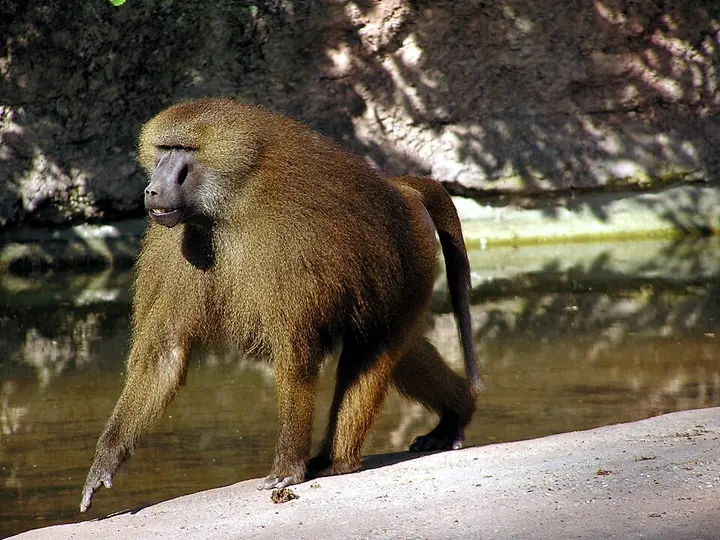
The Guinea baboon is a baboon from the Old World monkey family. Some (older) classifications list only two species in the genus Papio, this one and the hamadryas baboon. In those classifications, all other Papio species are considered subspecies of P. papio and the species is called the savanna baboon.
The Guinea baboon inhabits a small area in western Africa. Its range includes Guinea, Senegal, Gambia, southern Mauritania and western Mali. Its habitat includes dry forests, gallery forests, and adjoining bush savannas or steppes. It has reddish-brown hair, a hairless, dark-violet or black face with the typical dog-like muzzle, which is surrounded by a small mane, and a tail carried in a round arc. It also has limb modifications that allow it to walk long distances on the ground. The Guinea baboon is one of the smallest baboon species, weighing between 13 and 26 kg (28.6–57 lbs). Their life spans are generally between 20 and 50 years. It is a diurnal and terrestrial animal, but sleeps in trees or high rocks at night, away from predators.
Appearance
Baboon refers to the large-bodied primates with marked sexual dimorphism and having females and young that are dependent on males for protection. Guinean baboons have a red tone to their fur, and are sometimes referred to as the red baboon. They lack hair on their hindquarters, and their faces are black with yellow-brown sideburns. Females' rumps are pink in color and males have a mane of fur around their heads and shoulders.
Behaviour
Guinea baboons are diurnal, living on the ground instead of in trees, and typically sleep in trees at the terminal ends of branches. Their group size is widely variable and ranges from 30 to 200. However, the most common troop size is 30–40 individuals. Often, a pronounced male hierarchy and fierce competition for females happens within the group. This competition leads to sexual dimorphism among the species.
Diet
Like other baboon species, Guinea baboons will eat any available foods, but their main sources are fruits, roots, tubers, grass, seeds and leaves. They also will eat insects, worms, spiders, small mammals, birds and invertebrates.
Habitat
Generally found in woodland savannas, Guinea baboons seasonally congregate near permanent water sources, breaking off in the wet season into smaller groups. Although baboon species are all allopatric, some of their ranges do overlap, and interbreeding does occasionally occur. These baboons are found in a wide range across Africa in savannah habitats including Guinea, Senegal, Gambia, southern Mauritania and western Mali.
Where the Guinea baboon lives
Recorded in Gambia, Senegal, Mauritania and Guinea (Africa).
Most records fall in Central River, Tambacounda, West Coast, Lower River, Assaba and Kédougou.
See the Guinea baboon’s range on the globe
Conservation status
Near threatened (NT). Not at risk yet, but could be soon. Categories are the IUCN Red List as republished by GBIF.
Sources
The range is a density of 913 georeferenced GBIF records, shown on the continents where it is mainly recorded, not an expert-drawn map. Description from Wikipedia.