Animals / Mammal
Groundhog
Marmota monax · Sciuridae
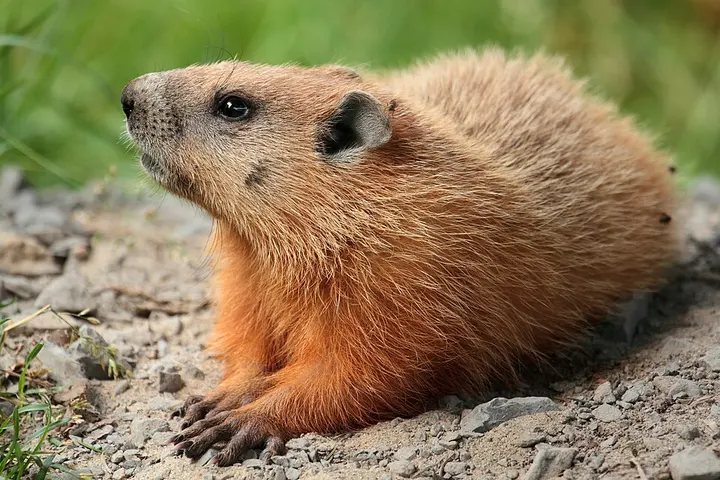
The groundhog, also known as the woodchuck, is a rodent of the family Sciuridae, belonging to the group of large ground squirrels known as marmots. A lowland creature of North America, it is found through much of the Eastern United States, across Canada and into Alaska. It was given its scientific name as Mus monax by Carl Linnaeus in 1758, based on a description of the animal by George Edwards, published in 1743.
The groundhog, being a lowland animal, is exceptional among marmots. Other marmots, such as the yellow-bellied and hoary marmots, live in rocky and mountainous areas. Groundhogs are considered one of the most solitary of marmot species. They live in aggregations, and their social organization and long-term pair bonds varies across populations. The groundhog's male and female interactions are usually limited to the mating season and copulation. However, certain populations of groundhogs have been observed to form long-term adult male-female association throughout the year, and often from year to year. The groundhog is an important contributor to the maintenance of healthy soil in woodlands and plains; as such, the species is considered a crucial habitat engineer.
Appearance
The groundhog is the largest sciurid in its geographical range, excluding its presence in British Columbia where its range may be comparable to that of its somewhat larger cousin, the hoary marmot. Adults may measure from 41.8 to 68.5 cm (16+7⁄16 to 26+15⁄16 in) in total length, including a tail of 9.5 to 18.7 cm (3+3⁄4 to 7+3⁄8 in). Weights of adult groundhogs typically fall between 2 and 6.3 kg (4 lb 7 oz and 13 lb 14 oz).
Behaviour
W.J. Schoonmaker reports that groundhogs may hide when they see, smell, or hear an observer. Marmot researcher Ken Armitage states that the social biology of the groundhog is poorly studied. Despite their heavy-bodied appearance, groundhogs are accomplished swimmers and occasionally climb trees when escaping predators or when they want to survey their surroundings.
Diet
Mostly herbivorous, groundhogs eat primarily wild grasses and other vegetation, including berries, bark, leaves, and agricultural crops, when available. In early spring, dandelion and coltsfoot are important groundhog food items. Some additional foods include sheep sorrel, timothy-grass, buttercup, persicaria, agrimony, red and black raspberries, mulberries, buckwheat, plantain, wild lettuce, alfalfa, and all varieties of clover.
Habitat
The groundhog dwells in lowland habitats, unlike other marmots that live in rocky and mountainous areas. Marmota monax has a wide geographic range. The groundhog prefers open country and the edges of woodland, being rarely found far from a burrow entrance. It can typically be found in small woodlots, low-elevation forests, fields and pastures, and hedgerows. It constructs dens in well-drained soil, and most groundhogs have summer and winter dens.
Where the Groundhog lives
Recorded in United States of America and Canada (North America).
Most records fall in Québec, New York, Ontario, Pennsylvania, Ohio and New Jersey.
See the Groundhog’s range on the globe
Conservation status
Least concern (LC). Not at risk: it is doing well in the wild. Categories are the IUCN Red List as republished by GBIF.
Sources
The range is a density of 48,636 georeferenced GBIF records, shown on the continents where it is mainly recorded, not an expert-drawn map. Description from Wikipedia.