Animals / Mammal
Ground pangolin
Smutsia temminckii · Manidae
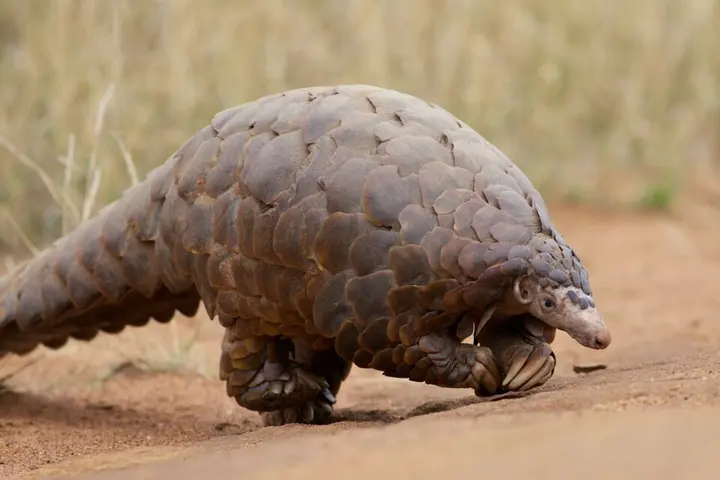
The ground pangolin, also known as Temminck's pangolin, Cape pangolin or steppe pangolin is a species of pangolin from genus Smutsia of subfamily Smutsiinae the within family Manidae. It is one of four species of pangolins which can be found in Africa, and the only one in southern and eastern Africa. The animal was named for the Dutch zoologist Coenraad Jacob Temminck.
Appearance
Pangolins are almost completely covered in overlapping, protective scales, which makes up about 20% of their body weight. The scales are composed of keratin, the same material that forms human hair and fingernails, and give pangolins an appearance similar to a pinecone or artichoke. The underside of a pangolin is not covered with scales, but sparse fur, instead. When threatened, it usually rolls up into a ball, thus protecting its vulnerable belly.
Diet
The ground pangolin is wholly myrmecophagous, meaning that they only feed on ants and termites. In fact, they demonstrate prey selectivity, only eating specific ant and termite species rather than foraging on the most abundant species. They have been observed exposing entire subterranean nests of a certain species of termites without eating any, preferring to find their species of choice.
Where the Ground pangolin lives
Recorded in South Africa, Mozambique, Namibia, Tanzania, Botswana, Zimbabwe, Kenya, Malawi and Uganda (Africa).
Most records fall in Limpopo, Sofala, Mpumalanga, Northern Cape, Otjozondjupa and KwaZulu-Natal.
See the Ground pangolin’s range on the globe
Conservation status
Vulnerable (VU). At risk: it could become endangered. Categories are the IUCN Red List as republished by GBIF.
Sources
The range is a density of 216 georeferenced GBIF records, shown on the continents where it is mainly recorded, not an expert-drawn map. Description from Wikipedia.