Animals / Bird
Greylag goose
Anser anser · Anatidae
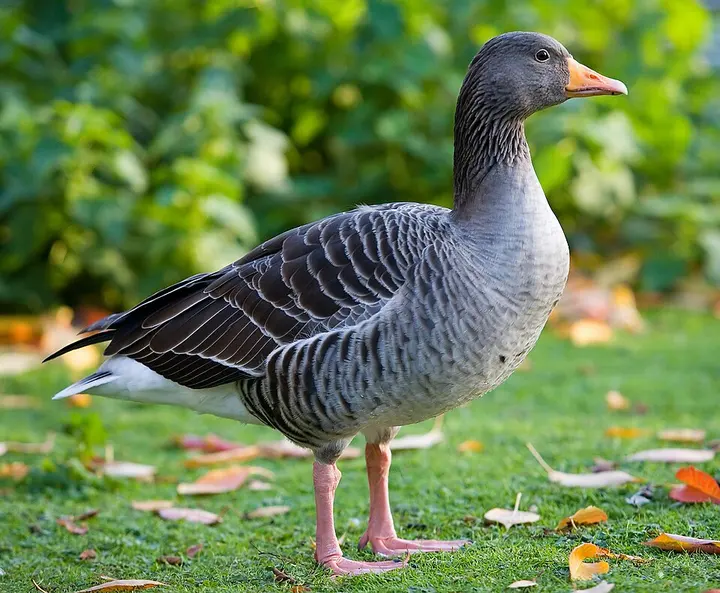
The greylag goose is a species of large goose in the waterfowl family Anatidae and the type species of the genus Anser. It has mottled and barred grey and white plumage and an orange beak and pink legs. A large bird, it measures between 74 and 91 centimetres in length, with an average weight of 3.3 kilograms.
Its distribution is widespread, with birds from the north of its range in Europe and Asia often migrating southwards to spend the winter in warmer places, although many populations are resident, even in the north. It is the ancestor of most breeds of domestic goose, having been domesticated at least as early as 1360 BCE. The genus name and specific epithet are from anser, the Latin for "goose". In the USA, its name has been spelled "graylag". Greylag geese travel to their northerly breeding grounds in spring, nesting on moorlands, in marshes, around lakes and on coastal islands. They normally mate for life and nest on the ground among vegetation. A clutch of three to five eggs is laid; the female incubates the eggs and both parents defend and rear the young.
Appearance
The greylag is the largest and bulkiest of the grey geese of the genus Anser, but is more lightly built and agile than its domestic relative. It has a rotund, bulky body, a thick and long neck, and a large head and bill. It has pink legs and feet, and an orange or pink bill with a white or brown nail (hard horny material at tip of upper mandible). It is 74 to 91 centimetres (29 to 36 in) long with a wing length of 41.2 to 48 centimetres (16+1⁄4 to 19 in).
Behaviour
Greylag geese are largely herbivorous and feed chiefly on grasses. Short, actively growing grass is more nutritious and greylag geese are often found grazing in pastures with sheep or cows. Because of its low nutrient status, they need to feed for much of their time; the herbage passes rapidly through the gut and is voided frequently.
Habitat
This species has a Palearctic distribution. The nominate subspecies breeds in Iceland, Norway, Sweden, Denmark, Finland, the Baltic States, northern Russia, Poland, eastern Hungary, Romania, Germany and the Netherlands. It also breeds locally in the United Kingdom, Belgium, Austria, the Czech Republic, Slovakia, North Macedonia and some other European countries. The eastern subspecies extends eastwards across a broad swathe of Asia to China.
Where the Greylag goose lives
Recorded in Sweden, Netherlands, Denmark, United Kingdom, Norway, Germany, Belgium, Spain and France (Europe).
Most records fall in Hovedstaden, Västra Götaland, Sjaælland, Syddanmark, Noord-Holland and Noord-Brabant.
See the Greylag goose’s range on the globe
Conservation status
Least concern (LC). Not at risk: it is doing well in the wild. Categories are the IUCN Red List as republished by GBIF.
Sources
The range is a density of 4,930,878 georeferenced GBIF records, shown on the continents where it is mainly recorded, not an expert-drawn map. Description from Wikipedia.