Animals / Bird
Grey heron
Ardea cinerea · Ardeidae
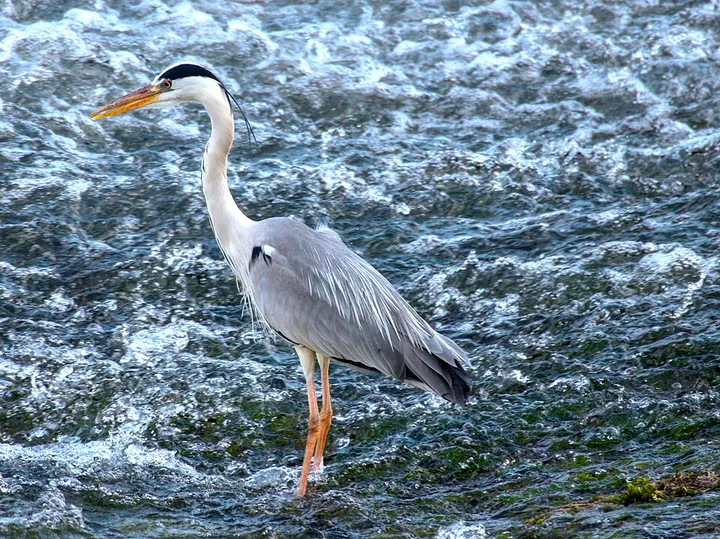
The grey heron is a long-legged wading bird of the heron family, Ardeidae, native throughout Europe, Asia, and most of Africa. It is resident in much of its range, but some populations from the more northern parts migrate southwards in autumn. A bird of wetland areas, it can be seen around lakes, rivers, ponds, marshes and on the sea coast.
It feeds mostly on aquatic creatures which it catches after standing stationary beside or in the water, or stalking its prey through the shallows. Standing up to 1 metre (3 ft 3 in) tall, adults weigh from 1 to 2 kg (2 to 4 lb). They have a white head and neck with a broad black stripe that extends from the eye to the black crest. The body and wings are grey above and the underparts are greyish-white, with some black on the flanks. The long, sharply pointed beak is pinkish-yellow and the legs are brown. The birds breed colonially in spring in heronries, usually building their nests high in trees. A clutch of usually three to five bluish-green eggs is laid. Both birds incubate the eggs for around 25 days, and then both feed the chicks, which fledge when 7–8 weeks old.
Appearance
The grey heron is a large bird, standing up to 100 cm (40 in) tall and measuring 84–102 cm (33–40 in) long with a 155–195 cm (61–77 in) wingspan. The body weight can range from 1.02–2.08 kg (2 lb 4 oz – 4 lb 9+1⁄4 oz). The plumage is largely ashy-grey above, and greyish-white below, with some black on the flanks. Adults have a white head and neck with a broad black supercilium that terminates in the slender, dangling crest, and bluish-black streaks on the front of the neck.
Behaviour
The grey heron has a slow flight, with its long neck retracted in an S-shape. This is characteristic of herons and bitterns, and distinguishes them from storks, cranes, and spoonbills, which extend their necks. It flies with slow wing-beats and sometimes glides for short distances. It sometimes soars, circling to considerable heights, but not as often as the stork.
Diet
Grey herons are important predators in their aquatic ecosystem. Fish, amphibians, crustaceans, and insects are caught in shallow water with the heron's long bill. It has also been observed catching and killing juvenile birds such as ducklings, and occasionally takes birds up to the size of a water rail or white-throated rail. Small mammals such as water voles, rats, stoats and young rabbits are additionally caught.
Habitat
The grey heron has an extensive range throughout most of the Palearctic realm. The range of the nominate subspecies A. c. cinerea extends to 70° N in Norway and 66°N in Sweden, but its northerly limit is around 60°N across the rest of Europe and Asia, as far eastwards as the Ural Mountains. To the south, its range extends to northern Spain, France, central Italy, the Balkans, the Caucasus, Iraq, Iran, India, The Maldives and Myanmar (Burma).
Where the Grey heron lives
Recorded in Netherlands, Sweden, United Kingdom, France, Denmark, Spain, Germany, Norway, India, Belgium, Taiwan, South Africa and Portugal (Europe, Asia and Africa).
Most records fall in Noord-Brabant, Zuid-Holland, Hovedstaden, Noord-Holland, Västra Götaland and Midtjylland.
See the Grey heron’s range on the globe
Conservation status
Least concern (LC). Not at risk: it is doing well in the wild. Categories are the IUCN Red List as republished by GBIF.
Sources
The range is a density of 7,895,529 georeferenced GBIF records, shown on the continents where it is mainly recorded, not an expert-drawn map. Description from Wikipedia.