Animals / Mammal
Grévy's zebra
Equus grevyi · Equidae
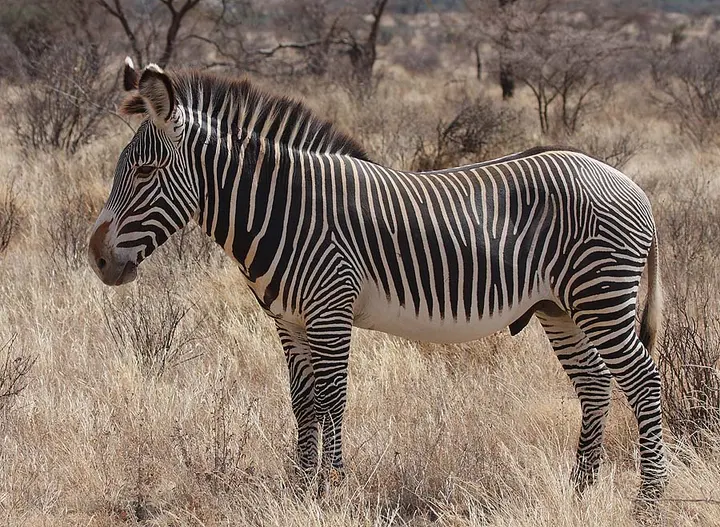
Grévy's zebra, also known commonly as the imperial zebra, is the largest living species of wild equid and the most threatened of the three species of zebras, the other two being the plains zebra and the mountain zebra. Named after French president Jules Grévy, it is found in parts of Kenya and Ethiopia. Superficially, Grévy's zebra's physical features can help to identify it from the other zebra species; its overall appearance is slightly closer to that of a mule and donkey, compared to the more "equine" (horse) appearance of the plains and mountain zebras.
Compared to other zebra species, Grévy's zebra is the tallest; it has mule-like, larger ears, and has the narrowest stripes of all zebras. It has a distinctively erect mane, and a more slender snout. Grévy's zebra lives in semi-arid savanna, where it feeds on grasses, legumes, and browse, such as acacia; it can survive up to five days without water. It differs from the other zebra species in that it does not live in a harem, and it maintains few long-lasting social bonds. Stallion territoriality and mother–foal relationships form the basis of the social system of the Grévy's zebra. Despite a handful of zoos and animal parks around the world having had successful captive-breeding programs, in its native home this zebra is listed by the IUCN as endangered.
Appearance
Grévy's zebra is the largest of all wild equines. It is 2.5–2.75 m (8.2–9.0 ft) in head-body length, with a tail 55–75 cm (1.80–2.46 ft) long, stands 1.45–1.6 m (4.8–5.2 ft) high at the withers, and weighs 350–450 kg (770–990 lb). Grévy's zebra differs from the other two zebras in its more primitive characteristics.
Life cycle
Grévy's zebras can mate and give birth year round, but most mating takes place in the early rainy seasons and births mostly take place in August or September after the long rains. An oestrous mare may visit as many as four territories a day and will mate with the stallions in them.
Where the Grévy's zebra lives
Recorded in Kenya and Ethiopia (Africa).
Most records fall in Rift Valley, Eastern, Coast, Oromiya, Afar and North-Eastern.
See the Grévy's zebra’s range on the globe
Conservation status
Endangered (EN). In danger of dying out in the wild. Categories are the IUCN Red List as republished by GBIF.
Sources
The range is a density of 911 georeferenced GBIF records, shown on the continents where it is mainly recorded, not an expert-drawn map. Description from Wikipedia.