Animals / Reptile
Green sea turtle
Chelonia mydas · Cheloniidae
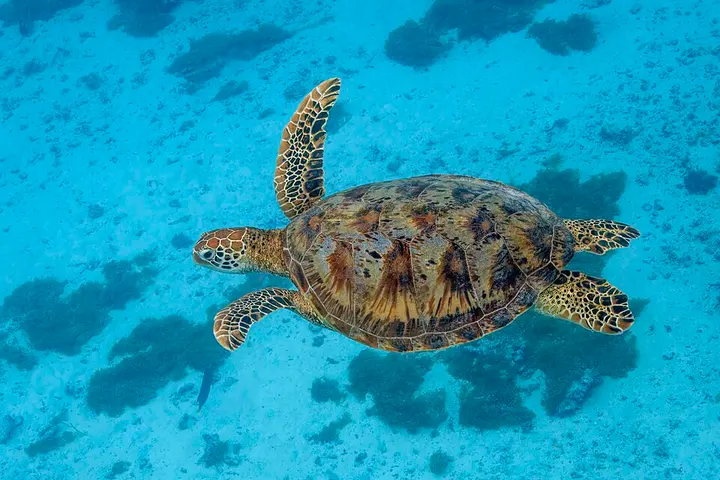
The green sea turtle, also known as the green turtle, black sea turtle, and Pacific green turtle, is a species of large sea turtle of the family Cheloniidae. It is the only species in the genus Chelonia. Its range extends throughout tropical and subtropical seas around the world, with two distinct populations in the Atlantic and Pacific Oceans, but it is also found in the Indian Ocean.
The common name refers to the usually green fat found beneath its carapace, due to its diet strictly being seagrass, not to the color of its carapace, which is olive to black. The dorsoventrally flattened body of C. mydas is covered by a large, teardrop-shaped carapace; it has a pair of large, paddle-like flippers. It is usually lightly colored, although in the eastern Pacific populations, parts of the carapace can be almost black. Unlike other members of its family, such as the hawksbill sea turtle, C. mydas is mostly herbivorous. The adults usually inhabit shallow lagoons, feeding mostly on various species of seagrasses. The green sea turtle is the only aquatic turtle species which is herbivorous when fully grown.
Appearance
Its appearance is that of a typical sea turtle. C. mydas has a dorsoventrally flattened body, a beaked head at the end of a short neck, and paddle-like arms well-adapted for swimming. Adult green turtles grow to 1.5 metres (5 ft) long. The average weight of mature individuals is 68–190 kg (150–419 lb) and the average carapace length is 78–112 cm (31–44 in). They are considered the second largest sea turtle in the United States, after the leatherback sea turtle.
Behaviour
As one of the first sea turtle species studied, much of what is known of sea turtle ecology comes from studies of green turtles. The ecology of C. mydas changes drastically with each stage of its life history. Newly emerged hatchlings are carnivorous, pelagic organisms, part of the open ocean nekton. In contrast, immature juveniles and adults are commonly found in seagrass meadows closer inshore as herbivorous grazers.
Diet
The diet of green turtles changes with age. Juveniles are carnivorous, but as they mature they become omnivorous. Young sea turtles eat fish and their eggs, sea hare eggs, hydrozoans, bryozoans, molluscs, jellyfish, small invertebrates, echinoderms, tunicates, insects, worms, sponges, algae, sea grasses, leaves, tree bark, and crustaceans. Green sea turtles have a relatively slow growth rate because of the low nutritional value of their diet.
Habitat
The range of the green sea turtle extends throughout tropical and subtropical oceans worldwide. The two major subpopulations are the Atlantic and the eastern Pacific subpopulations. Each population is genetically distinct, with its own set of nesting and feeding grounds within the population's known range. One of the genetic differences between the two subpopulations is the type of mitochondrial DNA found in individual's cells.
Where the Green sea turtle lives
Recorded in Ashmore and Cartier Is., United States of America, Brazil, United Arab Emirates, Ecuador, Mexico and Taiwan (Oceania, North America, South America and Asia).
Most records fall in Western Australia, Queensland, Hawaii, Florida, New South Wales and São Paulo.
See the Green sea turtle’s range on the globe
Conservation status
Least concern (LC). Not at risk: it is doing well in the wild. Categories are the IUCN Red List as republished by GBIF.
Sources
The range is a density of 253,602 georeferenced GBIF records, shown on the continents where it is mainly recorded, not an expert-drawn map. Description from Wikipedia.