Animals / Reptile
Green iguana
Iguana iguana · Iguanidae
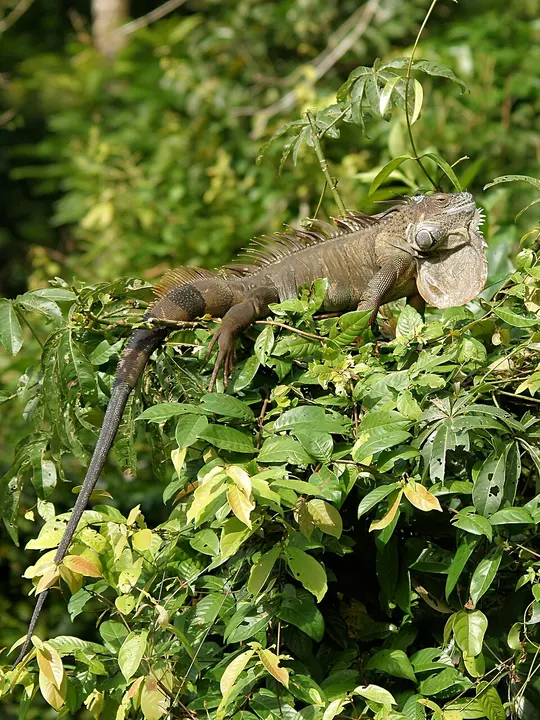
The green iguana, also known as the American iguana or the common green iguana, is a large, arboreal, mostly herbivorous species of lizard of the genus Iguana. Usually, this animal is simply called the iguana. The green iguana ranges over a large geographic area; it is native from southern Brazil and Paraguay as far north as Mexico.
It is highly invasive in many subtropical and tropical environments throughout the world. A herbivore, it has adapted significantly with regard to locomotion and osmoregulation as a result of its diet. It grows to 1.7 m (5.6 ft) in length from head to tail, although a few specimens have grown more than 2 m (6.6 ft) with bodyweights upward of 9 kg (20 lb). Although this species is commonly kept as a pet because of its disposition and coloration, it can be challenging to care for properly. Its requirements for adequate space, lighting, and heat can be difficult for hobbyists to meet.
Appearance
The green iguana is a large lizard and is probably the largest species in the iguana family, though a few in the genus Cyclura may match or exceed it in weight. Adults typically grow to 1.2 to 1.7 m (3.9 to 5.6 ft) in length from head to tail. As in all iguanas, the tail comprises much of this length, and the snout-to-vent length of most green iguanas is 30 to 42 cm (12 to 17 in).
Behaviour
Male green iguanas have highly developed femoral pores on the underside of their thighs, which secrete a scent (females have femoral pores, but they are smaller in comparison to those of the males). In addition, the dorsal spines that run along a green iguana's back are noticeably longer and thicker in males than they are in females, making the animals somewhat sexually dimorphic.
Diet
Although they consume a wide variety of foods if offered, green iguanas are naturally herbivorous and require a precise ratio of minerals (two to one calcium to phosphorus) in their diet. Captive iguanas must have a variety of leafy greens along with fruits and vegetables such as turnip greens, collard greens, butternut squash, acorn squash, mango, and parsnip.
Habitat
The native range of the green iguana extends from southern Mexico to central Brazil, Paraguay, and Bolivia and the Caribbean; specifically Grenada, Aruba, Curaçao, Bonaire, Trinidad and Tobago, St. Lucia, St. Vincent, Montserrat, Saba and Útila. People in the native regions utilize this species for food leading to increased captive breeding efforts.
Where the Green iguana lives
Recorded in Colombia, Mexico, Costa Rica, Brazil, Panama, Ecuador and Curaçao (South America and North America).
Introduced, not native, in United States of America and Puerto Rico.
Most records fall in Florida, Antioquia, Sinaloa, Santander, Limón and Alajuela.
See the Green iguana’s range on the globe
Conservation status
Least concern (LC). Not at risk: it is doing well in the wild. Categories are the IUCN Red List as republished by GBIF.
Sources
The range is a density of 79,720 georeferenced GBIF records, shown on the continents where it is mainly recorded, not an expert-drawn map. Description from Wikipedia.