Animals / Insect
Green darner
Anax junius · Aeshnidae
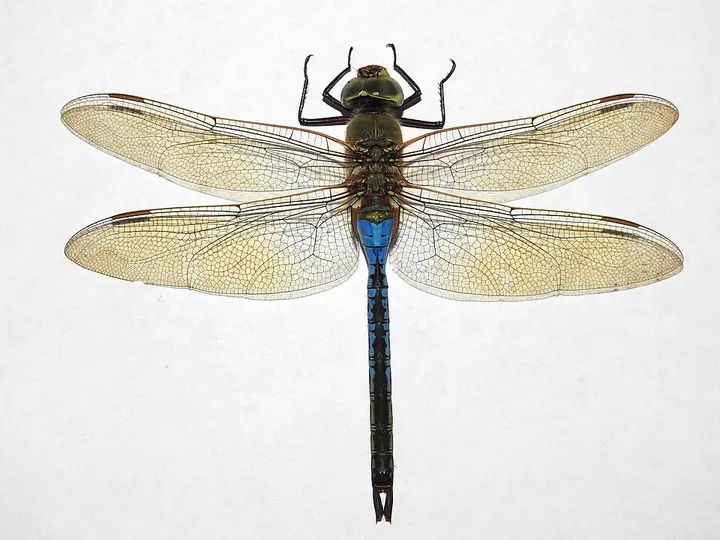
The green darner or common green darner, after its resemblance to a darning needle, is a species of dragonfly in the family Aeshnidae. One of the most common and abundant species throughout North America, it also ranges south to Panama. It is well known for its great migration distance from the northern United States south into Texas and Mexico.
It also occurs in the Caribbean, Tahiti, and Asia from Japan to mainland China. It is the official insect for the state of Washington in the United States. The green darner is a large dragonfly; males grow to 8 cm (3.1 in) in length with a wingspan up to 10 cm (4 in). Females oviposit in aquatic vegetation, eggs laid beneath the water surface. Nymphs (naiads) are aquatic carnivores, feeding on insects, tadpoles, and small fish. Adult darners catch insects on the wing, including ant alates, moths, mosquitoes, and flies.
Appearance
Common green darners are large dragonflies, ranging from 6.8 to 8 centimeters (2.7 to 3.1 in) in length and a wingspan of up to 10 centimeters (4 in). Both sexes have an unmarked green thorax. Mature males have bluish-purple abdomens (the first few abdominal segments are the brightest) with a black dorsal stripe that broadens near the end of the abdomen. Immature males and most females have reddish-brown abdomens, but some females are patterned like adult males.
Habitat
Common green darners are commonly found throughout the continental United States and southern Canada, occasionally ranging as far south as Panama, particularly in the winter. There are also populations in Hawaii and the Caribbean. Vagrant individuals have been seen far outside of their normal range including sightings in Alaska, Russia, China, Japan, France, the United Kingdom, India, and Bermuda.
Where the Green darner lives
Recorded in United States of America and Canada (North America).
Most records fall in Texas, Ohio, California, Ontario, Minnesota and New Jersey.
See the Green darner’s range on the globe
Conservation status
Least concern (LC). Not at risk: it is doing well in the wild. Categories are the IUCN Red List as republished by GBIF.
Sources
The range is a density of 63,454 georeferenced GBIF records, shown on the continents where it is mainly recorded, not an expert-drawn map. Description from Wikipedia.