Animals / Reptile
Green anaconda
Eunectes murinus · Boidae
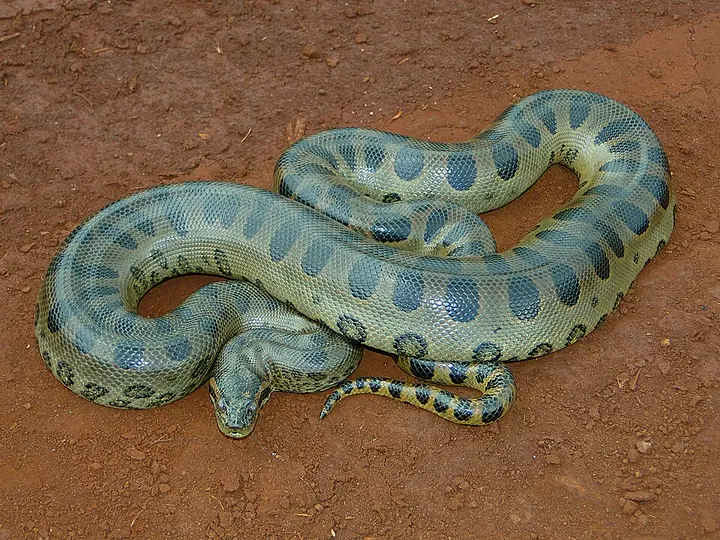
The green anaconda is a species of snake in the family Boidae (boas). The species is native to northern South America. It is one of the longest and heaviest known extant snake species.
Like all boas, it is a non-venomous constrictor. The green anaconda generally has a life expectancy of ten years in the wild, although some specimens live longer when taken care of in captivity. The green anaconda lives in tropical rainforests and tends to prefer shallow, slow-moving waters, such as streams, rivers, and flooded grasslands. It spends most of its time in the water but is also found on land in thick vegetation.
Appearance
The green anaconda is the world's heaviest and one of the world's longest snakes, reaching a total length (tail included) of up to 6.32 m (20 ft 9 in) long. More typical mature female specimens reportedly can range up to 5 m (16 ft 5 in), with a mean length of about 4.6 m (15 ft 1 in), being generally much larger than males, which average around 3 m (9 ft 10 in). Weights are less well studied, though reportedly range from 30 to 80 kg (66 to 176 lb) in a typical adult.
Behaviour
The green anaconda is mostly nocturnal and aquatic. It floats underwater and is known to swim quickly. Its eyes and nostrils are located on the top of the head, allowing the snake to breathe and watch for prey while the rest of the body is hidden underwater. When prey passes by or stops to drink, the green anaconda strikes, coils around the prey, constricts and suffocates it to death, and then swallows it whole.
Diet
The green anaconda is an apex predator with a wide variety of prey, almost anything it can overpower, including fishes, amphibians, birds, various mammals, and other reptiles. Particularly large specimens of the green anaconda may consume tapirs, deer, peccaries, capybaras, jaguars, and caimans, but such large meals are rare. Juvenile green anacondas feed on small birds and young caimans typically 40–70 grams (1.4–2.5 oz) in weight.
Life cycle
Individuals of the green anaconda are solitary until the mating season, which occurs during the rainy season, and can last several months, usually from April to May. Typically, females leave pheromone trails for males to follow, but how males track it is unclear. It may be that the pheromone is airborne. This theory is supported by the observation of females that remain motionless, while many males move towards them from all directions.
Where the Green anaconda lives
Recorded in Brazil, Colombia, Ecuador, Peru, Suriname and Venezuela (South America).
Most records fall in Sucumbios, Loreto, Casanare, Orellana, Meta and Amazonas.
See the Green anaconda’s range on the globe
Conservation status
Least concern (LC). Not at risk: it is doing well in the wild. Categories are the IUCN Red List as republished by GBIF.
Sources
The range is a density of 1,646 georeferenced GBIF records, shown on the continents where it is mainly recorded, not an expert-drawn map. Description from Wikipedia.