Animals / Bird
Greater roadrunner
Geococcyx californianus · Cuculidae
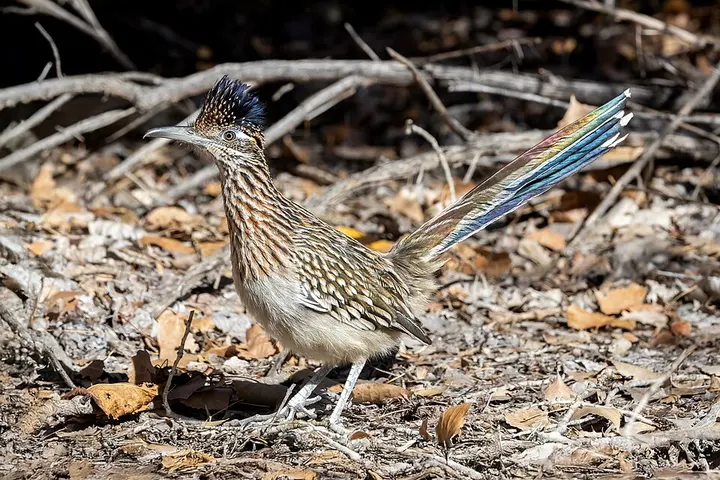
The greater roadrunner is a long-legged bird in the cuckoo family, Cuculidae, from the Aridoamerica region in the Southwestern United States and Mexico. The scientific name means "Californian earth-cuckoo". Along with the lesser roadrunner, it is one of two species in the genus Geococcyx.
This roadrunner is also known as the chaparral cock, ground cuckoo, and snake killer.
Appearance
The greater roadrunner is about 52–62 cm (20–24 in) long, has a 43–61 cm (17–24 in) wingspan, and weighs 221–538 g (7.8–19.0 oz). It stands around 25–30 cm (9+3⁄4–11+3⁄4 in) tall and is the largest cuckoo of the Americas. The upper body is mostly brown with black streaks and sometimes pink spots. The neck and upper breast are white or pale brown with dark brown streaks, and the belly is white.
Behaviour
The vocalizations of the greater roadrunner have seven distinct variants. The most frequent call is a slow and descending sequence of about six low, "cooing" noises, emitted by the male and which is heard at 820 ft (250 m). This call is usually made early in the morning, from a high perch such as a fence post, dead tree, or cactus. Females give off up to 22 short, low-frequency shrills, resembling coyote squeals, which can be heard 1,000 ft (300 m) away.
Diet
The greater roadrunner is omnivorous and uses its speed to outrun and catch prey. It feeds mainly on small animals, such as insects, spiders (including black widows and tarantulas), centipedes, scorpions, mice, small birds (including hummingbirds), lizards and young rattlesnakes, and some plants. Some instances of the greater roadrunner feeding on the dead carcasses of larger mammals (including bats, ground squirrels, and one juvenile desert cottontail) have been observed.
Habitat
The greater roadrunner is found in the Aridoamerica ecoregion, within the Southwestern United States and northern Mexico.
Where the Greater roadrunner lives
Recorded in United States of America and Mexico (North America).
Most records fall in Arizona, Texas, California, New Mexico, Nevada and Oklahoma.
See the Greater roadrunner’s range on the globe
Conservation status
Least concern (LC). Not at risk: it is doing well in the wild. Categories are the IUCN Red List as republished by GBIF.
Sources
The range is a density of 575,224 georeferenced GBIF records, shown on the continents where it is mainly recorded, not an expert-drawn map. Description from Wikipedia.