Animals / Mammal
Greater kudu
Tragelaphus strepsiceros · Bovidae
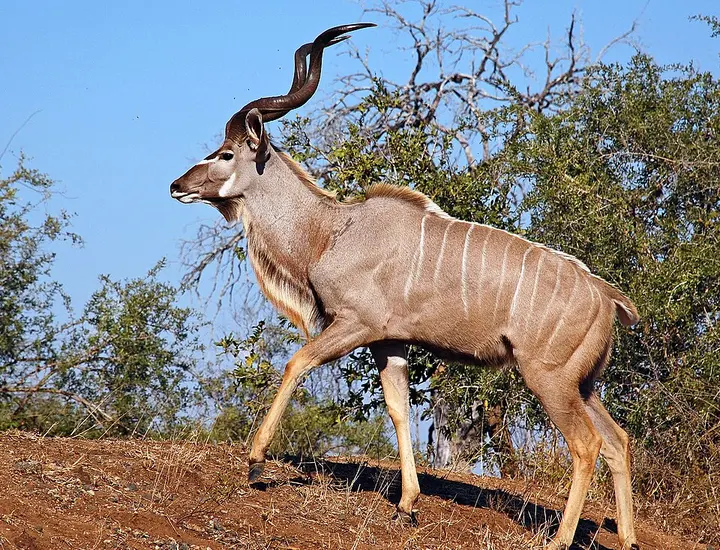
The greater kudu is a large woodland antelope, found throughout eastern and southern Africa. Despite occupying such widespread territory, they are sparsely populated in most areas due to declining habitat, deforestation, and poaching. The greater kudu is one of two species commonly known as kudu, the other being the lesser kudu, T. imberbis.
It was once placed as the only species in the genus Strepsiceros, which is now considered a subgenus.
Appearance
Greater kudus have a narrow body with long legs, and their coats can range from brown/bluish grey to reddish brown. They possess between 4 and 12 vertical white stripes along their torso. The head tends to be darker in colour than the rest of the body, and exhibits a small white chevron which runs between the eyes. Greater kudu bulls tend to be much larger than the cows, and vocalize much more, utilizing low grunts, clucks, humming, and gasping.
Life cycle
Greater kudus reach sexual maturity between ages 1 to 3. The mating season occurs at the end of the rainy season, which can fluctuate slightly according to the region and climate. Before mating, there is a courtship ritual which consists of the male standing in front of the female and often engaging in a neck wrestle. The male then trails the female while issuing a low pitched call until the female allows him to copulate with her.
Where the Greater kudu lives
Recorded in South Africa, Namibia, Botswana, Zambia, Zimbabwe, Angola and Kenya (Africa).
Most records fall in Mpumalanga, Limpopo, KwaZulu-Natal, Eastern Cape, North-West and Oshikoto.
See the Greater kudu’s range on the globe
Conservation status
Least concern (LC). Not at risk: it is doing well in the wild. Categories are the IUCN Red List as republished by GBIF.
Sources
The range is a density of 13,287 georeferenced GBIF records, shown on the continents where it is mainly recorded, not an expert-drawn map. Description from Wikipedia.