Animals / Bird
Greater flamingo
Phoenicopterus roseus · Phoenicopteridae
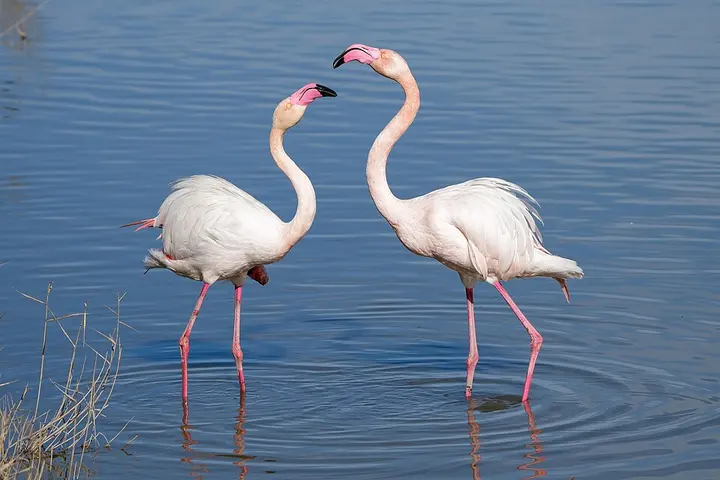
The greater flamingo is the largest and most widespread species of the flamingo family. Common in the Old World, they are found in Northern (coastal) and Sub-Saharan Africa, the Indian subcontinent, Central Asia, the Middle East, the Levant, the Persian Gulf, the Gulf of Aden, the Red Sea, and the Mediterranean countries of Southern Europe.
Appearance
The greater flamingo is the largest living species of flamingo, averaging 110–150 cm (43–59 in) tall and weighing 2–4 kg (4.4–8.8 lb). Most of the plumage is pinkish-white, but the wing coverts are red and the primary and secondary flight feathers are black. The bill is pink with a restricted black tip, and the legs are entirely pink. The call is a goose-like honking. Chicks are covered in grey fluffy down. Subadult flamingos are paler with dark legs.
Behaviour
Like all flamingos, this species lays a single chalky-white egg on a mud mound. Adult greater flamingos have few natural predators. Eggs and chicks may be eaten by raptors, crows, gulls, and the marabou stork (Leptoptilos crumenifer); an estimated half of the predation of greater flamingo eggs and chicks in the Mediterranean region is from the yellow-legged gull (Larus michahellis).
Diet
The greater flamingo resides in mudflats and shallow coastal lagoons with salt water. Using its feet, the bird stirs up the mud, then sucks water through its bill and filters out small shrimp, brine shrimp, other crustaceans, seeds (such as rice), blue-green algae, microalgae, other microscopic organisms (such as diatoms), aquatic insects and their larvae (such as chironomids), molluscs, annelids, nematodes, and small fish.
Habitat
It is found in parts of Northern Africa (including coastal areas of northern Algeria, Egypt further inland along the Nile River, Libya, Morocco, and Tunisia), portions of Sub-Saharan Africa (Kenya, Madagascar, Rwanda, Tanzania, Uganda), Southern Asia (coastal Bangladesh, India, Pakistan, and Sri Lanka), the Western Asia (Bahrain, Cyprus, Iraq, Iran, Oman, Israel, Palestine, Kuwait, Lebanon, Qatar, and the United Arab Emirates) and Southern Europe (including Albania, Bulgaria, Croatia, France in the Camargue and Corsica, Greece, Italy, Slovenia, Malta, Monaco, Montenegro, North Macedonia, Portugal, Spain and the Balearic Islands, and Turkey).
Life cycle
Unlike many other species of long-lived birds, greater flamingos do not form pair bonds that last over consecutive breeding seasons. When considering prospective breeding partners, there appears to be a preference for older, more experienced individuals. As both sexes seem to show this preference, pairs tend to consist of individuals of similar age. The species is well known for their courtship displays in large mixed-sexed groups.
Where the Greater flamingo lives
Recorded in Spain, France, Portugal, India, South Africa, United Arab Emirates, Italy, Greece, Netherlands, Israel and Turkey (Europe, Asia and Africa).
Most records fall in Bouches-du-Rhône, Hérault, Var, Faro, Tarragona and Cádiz.
See the Greater flamingo’s range on the globe
Conservation status
Least concern (LC). Not at risk: it is doing well in the wild. Categories are the IUCN Red List as republished by GBIF.
Sources
The range is a density of 554,683 georeferenced GBIF records, shown on the continents where it is mainly recorded, not an expert-drawn map. Description from Wikipedia.