Animals / Bird
Greater bird-of-paradise
Paradisaea apoda · Paradisaeidae
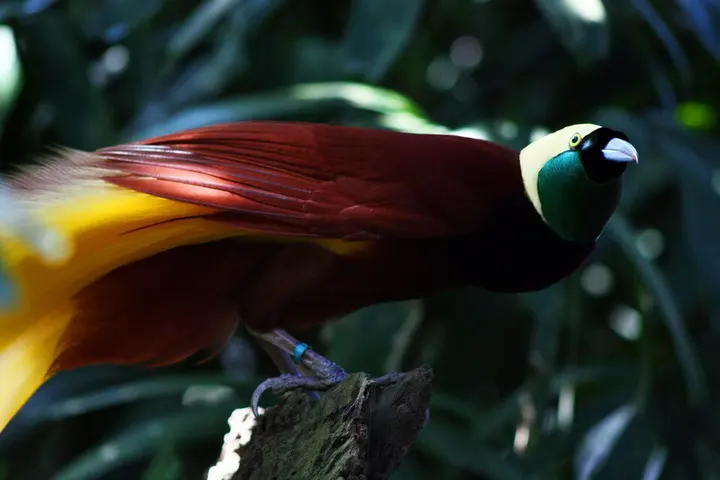
The greater bird-of-paradise is a bird-of-paradise in the genus Paradisaea.
Carl Linnaeus named the species Paradisaea apoda, or "legless bird-of-paradise", because early trade skins to reach Europe were prepared without wings or feet by the indigenous New Guinean people; this led to the misconception that these birds were beautiful visitors from paradise that were kept aloft by their plumes and never touched the earth until death.
Appearance
The greater bird-of-paradise is the largest member of the genus Paradisaea, with "the most glamorous display in the bird world". The males measure up to 43 cm (17 in), excluding the long, twin tail-wires. The female is smaller, at roughly 35 cm (14 in). The plumage of this species is highly sexually dimorphic; the male is highly colourful, with a notable profusion of yellow tail feathers which are used in courtship displays.
Behaviour
Greater birds-of-paradise, like the majority of their relatives, are frugivorous insectivores (less-technically considered "omnivores"), being highly fond of tree fruits and arthropods; their consumption of specific fruits, such as those of certain mahogany (Swietenia sp) and nutmeg (Myristica sp) trees, assists the different botanical species in colonising new areas, thus promoting biodiversity in the jungle.
Diet
Greater birds-of-paradise, like the majority of their relatives, are frugivorous insectivores (less-technically considered "omnivores"), being highly fond of tree fruits and arthropods; their consumption of specific fruits, such as those of certain mahogany (Swietenia sp) and nutmeg (Myristica sp) trees, assists the different botanical species in colonising new areas, thus promoting biodiversity in the jungle.
Habitat
The greater bird-of-paradise is distributed to lowland and hill forests of southwest New Guinea and Aru Islands, Indonesia. The diet consists mainly of fruits, seeds, and small insects. A small population was introduced by Sir William Ingram in 1909-1912 to Little Tobago Island of West Indies in an attempt to save the species from extinction due to overhunting for plume trades.
Where the Greater bird-of-paradise lives
Recorded in Papua New Guinea and Indonesia (Oceania and Asia).
Most records fall in Western, Papua, Maluku, Morobe, National Capital District and Chimbu.
See the Greater bird-of-paradise’s range on the globe
Conservation status
Least concern (LC). Not at risk: it is doing well in the wild. Categories are the IUCN Red List as republished by GBIF.
Sources
The range is a density of 1,571 georeferenced GBIF records, shown on the continents where it is mainly recorded, not an expert-drawn map. Description from Wikipedia.