Animals / Fish
Great white shark
Carcharodon carcharias · Lamnidae
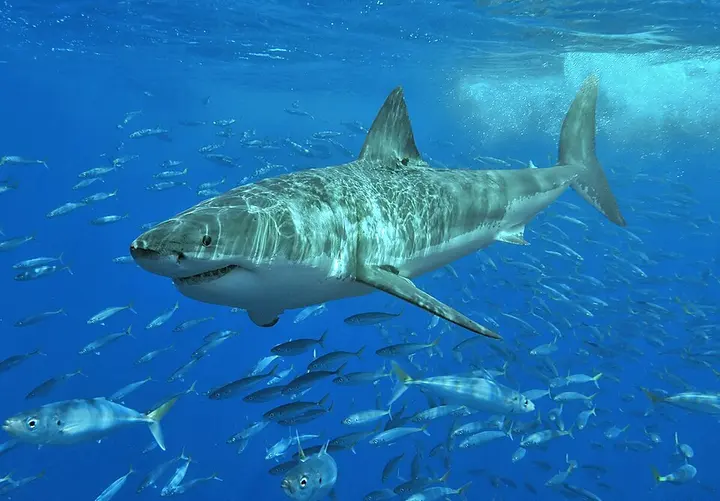
The great white shark, also known as the white shark, white pointer, or great white, is a large shark. It is closely related to the mako sharks, the porbeagle, and the salmon shark. It is a robustly built species with a grayish upperside and a white underside.
The white shark is one of the largest living shark and fish species, though it is still smaller than the whale shark and basking shark. It has about 300 triangular, serrated teeth that are continuously replaced. Its massive, fatty liver can reach over a quarter of its body weight, providing buoyancy and storing energy. The species is partially warm-blooded, an adaptation that allows it to remain active in colder waters. White sharks inhabit tropical and temperate ocean waters around the world and can be found both near coasts and in the open ocean. Populations are most concentrated at the Pacific and Atlantic of North America and in the waters of southern Africa and Oceania. They are a highly migratory species, traveling between the coast and the open ocean and even between continents.
Appearance
The white shark is one of the largest living sharks and fish but is smaller than the whale shark and basking shark. Female white sharks are mature at 4.6–4.9 m (15–16 ft) while males are mature at 3.4–4.0 m (11–13 ft). Females weigh 1,000–1,900 kg (2,200–4,200 lb) while males weigh 680–1,000 kg (1,500–2,200 lb). The maximum size of the white shark has been debated.
Behaviour
White sharks are estimated to swim 2.88–4.86 km/h (1.79–3.02 mph) but can sprint up to 24.12 km/h (14.99 mph). One individual was recorded cruising at a sustained speed of 4.7 km/h (2.9 mph) while migrating, which is fast for a shark and more similar to fast-swimming tuna. White sharks display various surface behaviors.
Diet
The white shark is an apex predator that opportunistically feeds on fish, cephalopods (like squid), marine mammals, sea birds, and sea turtles. Diet differs based on size and age; individuals over 3 m (10 ft) can feed on marine mammals, while juveniles are limited to smaller prey like fish and cephalopods. White sharks prefer prey with high fat content, but even large individuals are recorded to eat low-fat foods.
Habitat
White sharks range from tropical to temperate and even colder waters around the world with major populations in northwestern and northeastern Pacific, western North Atlantic, the Mediterranean, southern African waters and Oceania. It is also present near the coasts of South America but appears to be uncommon.
Where the Great white shark lives
Recorded in Ashmore and Cartier Is., United States of America, New Zealand, Brazil and South Africa (Oceania, North America, South America and Africa).
Most records fall in New South Wales, California, South Australia, Southland, Chatham Islands Territory and Western Cape.
See the Great white shark’s range on the globe
Conservation status
Vulnerable (VU). At risk: it could become endangered. Categories are the IUCN Red List as republished by GBIF.
Sources
The range is a density of 17,027 georeferenced GBIF records, shown on the continents where it is mainly recorded, not an expert-drawn map. Description from Wikipedia.