Animals / Bird
Great white pelican
Pelecanus onocrotalus · Pelecanidae
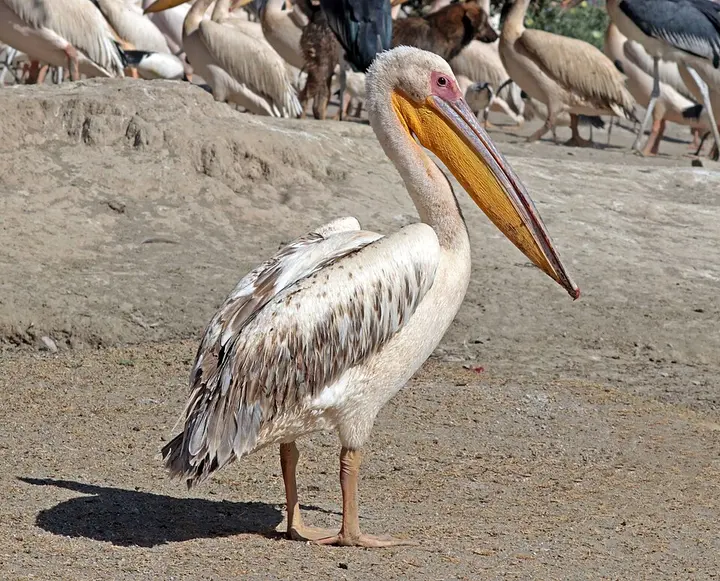
The great white pelican, also known as the eastern white pelican, rosy pelican or simply white pelican, is a bird in the pelican family. It breeds from southeastern Europe through Asia and Africa, in swamps and shallow lakes.
The great white pelican has been rated as a species of least concern on the IUCN Red List of Endangered Species (IUCN). It is listed under Appendix I of the Convention on the Conservation of Migratory Species of Wild Animals, Annexure I under the EU Birds Directive on the Conservation of Wild Birds, and Appendix II of the Berne Convention on the Conservation of European Wildlife and Natural Habitats. It is also listed within 108 Special Protection Areas in the European Union. It occurs within 43 Important Bird Areas (IBAs) in its European range. It is one of the species to which the Agreement on the Conservation of African-Eurasian Migratory Waterbirds (AEWA) is applied.
Appearance
The great white pelican is a huge bird—only the Dalmatian pelican is, on average, larger among pelicans. It measures 140 to 180 cm (55 to 71 in) in length with a 28.9 to 47.1 cm (11.4 to 18.5 in) enormous pink and yellow bill, and a dull pale-yellow gular pouch. The wingspan measures 226 to 360 cm (7 ft 5 in to 11 ft 10 in), the latter measurement being the highest among extant flying animals outside of the great albatross.
Behaviour
The great white pelican is highly sociable and often forms large flocks. It is well adapted for aquatic life. The short strong legs and webbed feet propel it in water and aid a rather awkward takeoff from the water surface. In flight, it is an elegant soaring bird, with the head held close to and aligned with the body. Its flight consists of a few slow wingbeats followed by a glide.
Diet
The great white pelican mainly eats fish. It leaves its roost to feed early in the morning and may fly over 100 km (62 mi) in search of food, as has been observed in Chad and in Mogode, Cameroon. It needs from 0.9 to 1.4 kg (2.0 to 3.1 lb) of fish every day, which corresponds to around 28,000,000 kg (62,000,000 lb) annual fish consumption at the largest colony of the great white pelican, on Tanzania's Lake Rukwa (with almost 75,000 birds).
Habitat
The breeding range of the great white pelican extends to Ethiopia, Tanzania, Chad, northern Cameroons, and Nigeria in Africa, and has been observed or reported breeding in Zambia, Botswana, and South Africa. In the 1990s, 6,700 to 11,000 breeding pairs in 23 to 25 breeding sites, were found in the Palearctic region. A 1991 study noted about 3,070 to 4,300 pairs were present in the Soviet Union.
Where the Great white pelican lives
Recorded in Israel, South Africa, India, Kenya, Namibia, Romania, Turkey, Greece, Netherlands, Tanzania, Bulgaria, Senegal and Ethiopia (Asia, Africa and Europe).
Most records fall in Western Cape, HaZafon, Gujarat, Rift Valley, Haifa and KwaZulu-Natal.
See the Great white pelican’s range on the globe
Conservation status
Least concern (LC). Not at risk: it is doing well in the wild. Categories are the IUCN Red List as republished by GBIF.
Sources
The range is a density of 134,658 georeferenced GBIF records, shown on the continents where it is mainly recorded, not an expert-drawn map. Description from Wikipedia.