Animals / Bird
Great tit
Parus major · Paridae
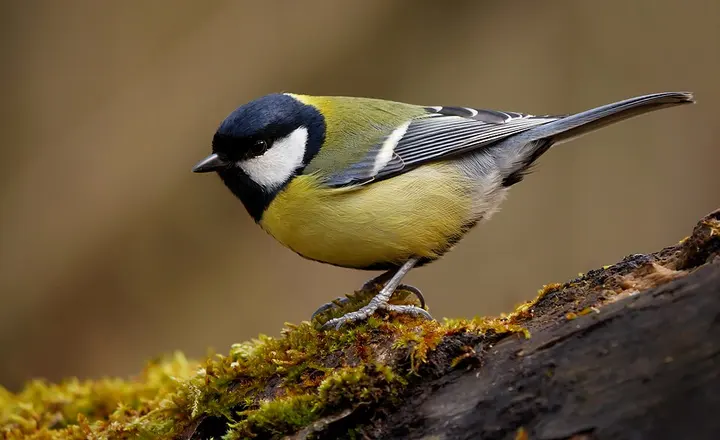
The great tit is a small passerine bird in the tit family Paridae. It is widespread and common throughout Europe, the Middle East, Central Asia and as far east as the Amur River. It also occurs in parts of North Africa where it is generally resident in any sort of woodland.
Most great tits do not migrate, except in extremely harsh winters. Until 2005 this species was lumped with numerous other subspecies. However, DNA studies have revealed that these subspecies are distinct from the great tit, and they have now been classified as two distinct species, the cinereous tit (Parus cinereus) of southern Asia, and the Japanese tit (Parus minor) of East Asia. The great tit remains the most widespread species in the genus Parus. The great tit is a distinctive bird with a black head and neck, prominent white cheeks, olive-coloured upperparts and yellow underparts. There is some variation amongst the numerous subspecies. Predominantly insectivorous in the summer, the species consumes a wider range of food items in the winter months, including small hibernating bats.
Appearance
The great tit is large for a tit at 12.5 to 14 cm (4+7⁄8–5+1⁄2 in) in length, and has a distinctive appearance that makes it easy to recognise. The nominate race P. major major has a bluish-black crown, black neck, throat, bib and head, and white cheeks and ear coverts. The breast is bright lemon-yellow and there is a broad black mid-line stripe running from the bib to vent. There is a dull white spot on the neck turning to greenish yellow on the upper nape.
Behaviour
Great tits are primarily insectivorous in the summer, feeding on insects and spiders which they capture by foliage gleaning. Their larger invertebrate prey include cockroaches, grasshoppers and crickets, lacewings, earwigs, bugs (Hemiptera), ants, flies (Diptera), caddisflies, beetles, scorpionflies, harvestmen, bees and wasps, snails and woodlice. During the breeding season, the tits prefer to feed protein-rich caterpillars to their young.
Diet
Great tits are primarily insectivorous in the summer, feeding on insects and spiders which they capture by foliage gleaning. Their larger invertebrate prey include cockroaches, grasshoppers and crickets, lacewings, earwigs, bugs (Hemiptera), ants, flies (Diptera), caddisflies, beetles, scorpionflies, harvestmen, bees and wasps, snails and woodlice. During the breeding season, the tits prefer to feed protein-rich caterpillars to their young.
Life cycle
Great tits are monogamous breeders and establish breeding territories. These territories are established in late January and defence begins in late winter or early spring. Territories are usually reoccupied in successive years, even if one of the pair dies, so long as the brood is raised successfully. Females are likely to disperse to new territories if their nest is predated the previous year.
Where the Great tit lives
Recorded in Sweden, Finland, France, Netherlands, United Kingdom, Norway, Spain, Germany, Denmark, Poland, Belgium and Russia (Europe).
Most records fall in Uusimaa, Västra Götaland, Stockholm, Finland Proper, Noord-Holland and Noord-Brabant.
See the Great tit’s range on the globe
Conservation status
Least concern (LC). Not at risk: it is doing well in the wild. Categories are the IUCN Red List as republished by GBIF.
Sources
The range is a density of 14,074,358 georeferenced GBIF records, shown on the continents where it is mainly recorded, not an expert-drawn map. Description from Wikipedia.