Animals / Bird
Great horned owl
Bubo virginianus · Strigidae
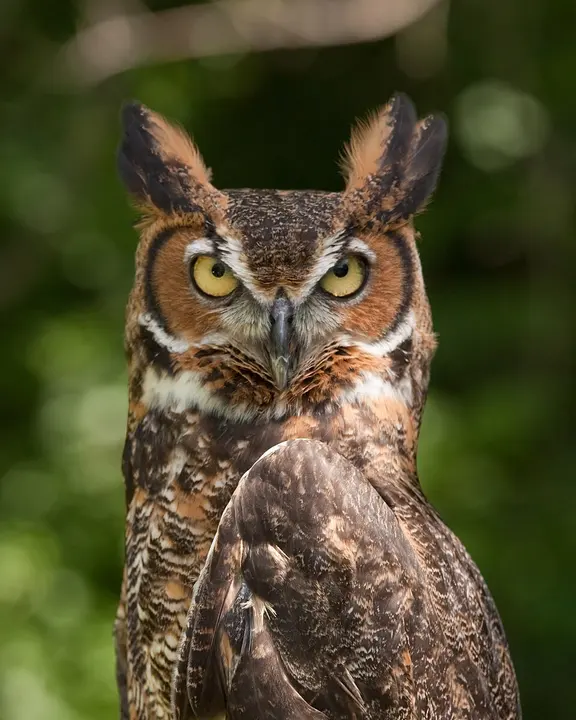
The great horned owl, also known as the tiger owl or the hoot owl, is a large owl native to the Americas. It is an extremely adaptable bird with a vast range and is the most widely distributed true owl in the Americas. Its diet consists primarily of rabbits and hares, rats and mice, and voles; it remains one of the few regular predators of skunk.
Hunting also includes rodents, larger mid-sized mammals, birds, reptiles, amphibians, and invertebrates. In ornithological study, the great horned owl is often compared to the Eurasian eagle-owl (Bubo bubo), a closely related species, which occupies the same ecological niche in Eurasia despite its notably larger size. The great horned owl is also compared to the red-tailed hawk (Buteo jamaicensis), with which it often shares similar habitat, prey, and nesting habits by day; thus the red-tailed hawk is something of a diurnal ecological equivalent. The great horned owl is one of the earliest nesting birds in North America, often laying eggs weeks or even months before other raptorial birds.
Appearance
The great horned owl is generally colored for camouflage. The underparts of the species are usually light with some brown horizontal barring; the upper parts and upper wings are generally a mottled brown usually bearing heavy, complex, darker markings. All subspecies are darkly barred to some extent along the sides. A variable-sized white patch is seen on the throat.
Behaviour
In most aspects of their behavior, great horned owls are typical of owls and most birds of prey. Like most owls, the great horned owl makes great use of secrecy and stealth. Due to its natural-colored plumage, it is well camouflaged both while active at night and while roosting during the day.
Habitat
The breeding habitat of the great horned owl extends high into the subarctic of North America, where they are found up to the northwestern and southern Mackenzie Mountains, Keewatin, Ontario, northern Manitoba, Fort Chimo in Ungava, Okak, Newfoundland and Labrador, Anticosti Island and Prince Edward Island.
Life cycle
Great horned owls are some of the earliest-breeding birds in North America, seemingly in part because of the lengthy nightfall at this time of year and additionally the competitive advantage it gives the owl over other raptors. In most of North America, courtship is from October to December and mates are chosen by December to January.
Where the Great horned owl lives
Recorded in United States of America and Canada (North America).
Most records fall in California, Texas, Colorado, Arizona, Florida and Oregon.
See the Great horned owl’s range on the globe
Conservation status
Least concern (LC). Not at risk: it is doing well in the wild. Categories are the IUCN Red List as republished by GBIF.
Sources
The range is a density of 1,646,201 georeferenced GBIF records, shown on the continents where it is mainly recorded, not an expert-drawn map. Description from Wikipedia.