Animals / Bird
Great blue heron
Ardea herodias · Ardeidae
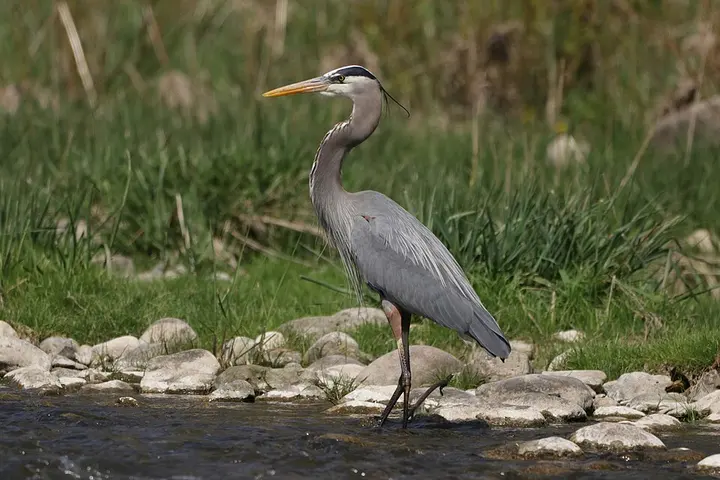
The great blue heron is a large wading bird in the heron family (Ardeidae), common near shores of open water and wetlands over most of North and Central America, as well as Northwestern South America, the Caribbean, and the Galápagos Islands. It is occasionally found in the Azores and is a rare vagrant to Europe. An all-white population found in South Florida, the Florida Keys, and the Caribbean islands, is known as the great white heron.
Debate exists about whether these white birds are a color morph of the great blue heron, a subspecies of it, or an entirely separate species.
Appearance
The great blue heron is the largest heron native to North America. Among all extant herons, it is surpassed in size only by the Goliath heron (Ardea goliath) and the white-bellied heron (Ardea insignis). It exhibits a minor degree of sexual dimorphism; males are slightly larger than females, but otherwise the sexes are not easily outwardly distinguishable.
Behaviour
The great blue heron (A. herodias) is widely recognized as an apex predator within many North American wetland systems. Its hunting behavior ranges across marshes, river edges, and shallow coastal zones, where it consumes fish, amphibians, reptiles, invertebrates, and small mammals, placing it at the top of local food webs.
Diet
The great blue heron (A. herodias) is widely recognized as an apex predator within many North American wetland systems. Its hunting behavior ranges across marshes, river edges, and shallow coastal zones, where it consumes fish, amphibians, reptiles, invertebrates, and small mammals, placing it at the top of local food webs.
Habitat
The great blue heron is found throughout most of North America, as far north as Alaska and the southern Canadian provinces in the summer. In winter, the range extends south through Florida, Mexico, and the Caribbean to far northwestern South America (regular in Colombia and Venezuela, accidental elsewhere in South America).
Life cycle
A. h. herodias is primarily migratory, while A. h. fannini is primarily not. This species usually breeds in colonies, in trees close to lakes or other wetlands. Adults generally return to the colony site after winter from December (in warmer climes such as California and Florida) to March (in cooler areas such as Canada). Usually, colonies include only great blue herons, though sometimes they nest alongside other species of herons.
Where the Great blue heron lives
Recorded in United States of America and Canada (North America).
Most records fall in California, Florida, Texas, New York, Ohio and Washington.
See the Great blue heron’s range on the globe
Conservation status
Least concern (LC). Not at risk: it is doing well in the wild. Categories are the IUCN Red List as republished by GBIF.
Sources
The range is a density of 14,216,355 georeferenced GBIF records, shown on the continents where it is mainly recorded, not an expert-drawn map. Description from Wikipedia.