Animals / Mammal
Golden snub-nosed monkey
Rhinopithecus roxellana · Cercopithecidae
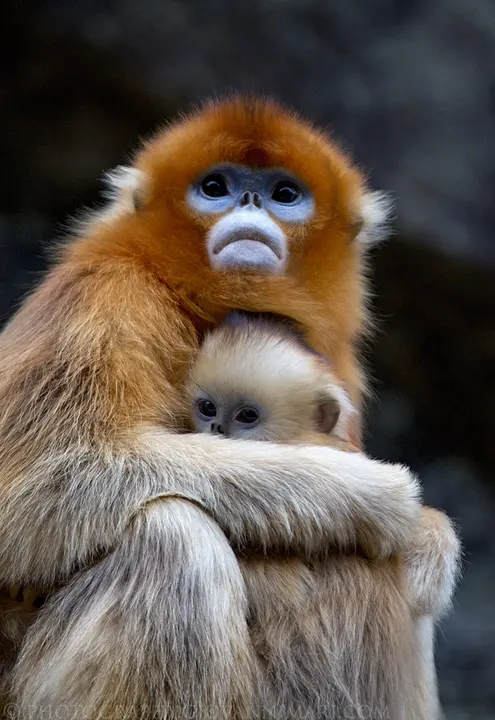
The golden snub-nosed monkey is an Old World monkey in the subfamily Colobinae. It is endemic to a small area in temperate, mountainous forests of central and Southwest China. They inhabit these mountainous forests of Southwestern China at elevations of 1,500–3,400 m (4,900–11,200 ft) above sea level.
The Chinese name is Sichuan golden hair monkey (四川金丝猴). It is also widely referred to as the Sichuan snub-nosed monkey. Of the three species of snub-nosed monkeys in China, the golden snub-nosed monkey is the most widely distributed throughout China. Snow occurs frequently within its range, and it can withstand colder average temperatures better than any other non-human primate. Its diet varies markedly with the seasons, but it is primarily a herbivore with lichens being its main food source. It is diurnal and largely arboreal, spending some 97% of its time in the canopy. There are three subspecies. Population estimates range from 8,000 to 15,000 and it is threatened by habitat loss.
Appearance
The adult and subadult golden snub-nosed monkey is sexually dimorphic. Adult males (estimated at over 7 years of age) have large bodies covered with very long, golden guard hairs on their backs and cape area. The crest is medium brown while the back, crown to nape, arms and outer thighs are deep brown. The brown crest also contains physically upright hairs, whose shape is useful for individual identification.
Behaviour
The golden snub-nosed monkey is found in groups ranging in size from 5–10 individuals to bands of about 600. The social organization of this species can be quite complex. The one-male-units (OMUs) are the basic social unit within groups of golden snub-nosed monkeys with many of the OMUs forming a bigger group. These multi-tier societies consist of several OMUs that include one adult male plus a number of adult females and their offspring.
Diet
The golden snub-nosed monkey eats (from greatest to least amount) lichens, young leaves, fruits or seeds, buds, mature leaves, herbs, bark, and flowers. This diet varies from season to season, showing a correlation once again between food availability and home range. This diet also shows a complicated seasonal variation.
Habitat
The distribution of the golden snub-nosed monkey is limited to temperate forests on mountains in four provinces in China: Sichuan, Gansu, Shaanxi, and Hubei. This monkey is found at elevations of 1,500-3,400 m. Within this area, vegetation varies with altitude from deciduous, broadleaf forests at low elevations to mixed coniferous, broadleaf forests above 2,200 m and coniferous forests above 2,600 m.
Life cycle
Females are sexually mature at about 5 years old. Males are sexually mature at about 5–7 years old. Mating may occur throughout the year but peaks in the month of October. This approximates gestation at 6–7 months in length. The golden snub-nosed monkey gives birth from March to June.
Where the Golden snub-nosed monkey lives
Recorded in China (Asia).
Most records fall in Sichuan, Hubei, Shaanxi and Gansu.
See the Golden snub-nosed monkey’s range on the globe
Conservation status
Endangered (EN). In danger of dying out in the wild. Categories are the IUCN Red List as republished by GBIF.
Sources
The range is a density of 113 georeferenced GBIF records, shown on the continents where it is mainly recorded, not an expert-drawn map. Description from Wikipedia.