Animals / Mammal
Golden jackal
Canis aureus · Canidae
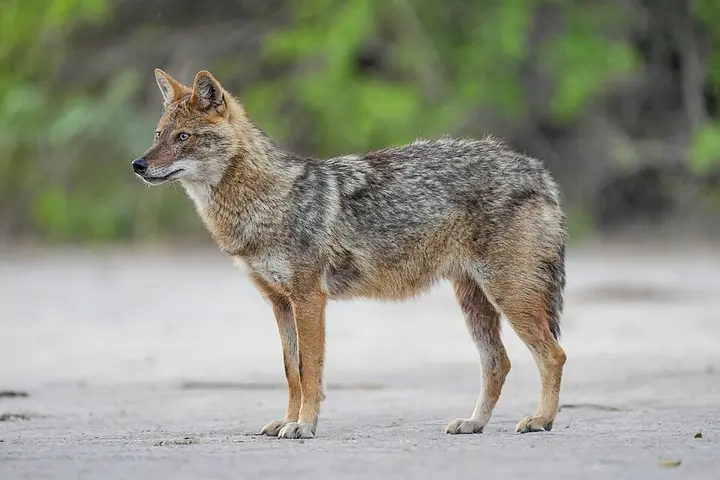
The golden jackal, also called the common jackal, is a wolf-like canid that is native to Eurasia. The golden jackal's coat varies in color from a pale creamy yellow in summer to a dark tawny beige in winter. It is smaller and has shorter legs, a shorter tail, a more elongated torso, a less-prominent forehead, and a narrower and more pointed muzzle than the Arabian wolf.
It is listed as Least Concern on the IUCN Red List due to its widespread distribution and high density in areas with plenty of available food and optimum shelter. Despite its name, the golden jackal is not closely related to the African black-backed jackal or the side-striped jackal, which are part of the genus Lupulella. It is instead closer to wolves and coyotes. The ancestor of the golden jackal is believed to be the extinct Arno river dog that lived in southern Europe 1.9 million years ago. It is described as having been a small, jackal-like canine. Genetic studies indicate that the golden jackal expanded from India around 20,000 years ago, towards the end of the last Last Glacial Maximum.
Appearance
The golden jackal is similar to the gray wolf but is distinguished by its smaller size, lighter weight, more elongated torso, less-prominent forehead, shorter legs and tail, and a muzzle that is narrower and more pointed. The legs are long in relation to its body, and the feet are slender with small pads. Males measure 71–85 cm (28–33 in) in body length and females 69–73 cm (27–29 in). Males weigh 6–14 kg (13–31 lb) and females weigh 7–11 kg (15–24 lb).
Behaviour
The golden jackal inhabits Europe and Southwest, Central, South, and Southeast Asia. The golden jackal's omnivorous diet allows it to eat a large range of foods; this diet, together with its tolerance of dry conditions, enables it to live in different habitats. The jackal's long legs and lithe body allow it to trot over great distances in search of food. It is able to go without water for extended periods and has been observed on islands that have no fresh water.
Life cycle
Golden jackals are monogamous and will remain with the one partner until death. Female jackals have only one breeding cycle each year. Breeding occurs from October to March in Israel and from February to March in India, Turkmenistan, Bulgaria, and Transcaucasia, with the mating period lasting up to 26–28 days. Females undergoing their first estrus are often pursued by several males that may quarrel among themselves.
Where the Golden jackal lives
Recorded in Israel and India (Asia).
Most records fall in HaZafon, HaDarom, Haifa, HaMerkaz, Jerusalem and Madhya Pradesh.
See the Golden jackal’s range on the globe
Conservation status
Least concern (LC). Not at risk: it is doing well in the wild. Categories are the IUCN Red List as republished by GBIF.
Sources
The range is a density of 62,984 georeferenced GBIF records, shown on the continents where it is mainly recorded, not an expert-drawn map. Description from Wikipedia.