Animals / Mammal
Giant pangolin
Smutsia gigantea · Manidae
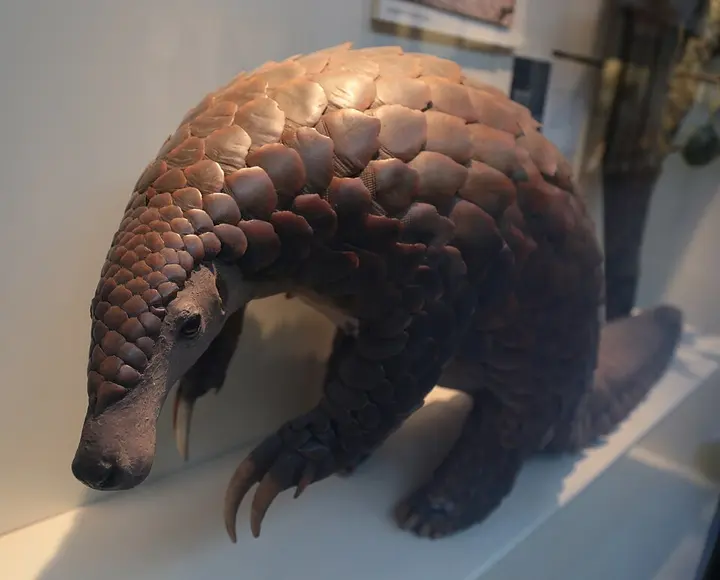
The giant pangolin is a species of pangolin from genus Smutsia of subfamily Smutsiinae within the family Manidae. It is the largest living species of pangolins. Members of the species inhabit Africa with a range stretching along the equator from West Africa to Uganda.
It subsists almost entirely on ants and termites.
Appearance
The giant pangolin is the largest of all pangolin species. While its average mass has not been measured, one specimen was found to weigh between 30 kg (66 lb) and 40 kg (88 lb). Males are larger than females, with male body lengths about 137 cm (54 in) to 180 cm (71 in) and females about 112.5 cm (44.3 in) to 136.5 cm (53.7 in). Like all pangolins, the species is armored with large, brown to reddish-brown scales formed from keratin. Curiously, it also has eyelashes.
Behaviour
The giant pangolin, like other pangolins, is nocturnal, which makes observation difficult. It is also usually solitary, although in one case an adult was seen in a burrow with a juvenile.
Diet
Like all pangolins, the giant pangolin is a specialized insectivore that lacks teeth and the ability to chew. Its diet mainly consists of ants and termites, which it finds by tearing open anthills and termite nests, both subterranean and mound-type.
Habitat
The giant pangolin inhabits many countries, with the largest concentration in Uganda, Tanzania. It is found mainly in the savanna, rainforest, and forest, inhabiting areas with large termite populations and available water. It does not inhabit high-altitude areas. A small number of recorded sightings have occurred in western Kenya within the East African montane forests, the first being reported in 1971, with subsequent sightings being made in 2018.
Life cycle
Very little information about the reproduction of the giant pangolin is known. Two birth records exist, with one litter in September and another in October, with the young weighing around 500 g (18 oz). As in all pangolins, infants have soft scales that eventually harden, and are born with open eyes. They cannot walk on their legs, but can move on their bellies.
Where the Giant pangolin lives
Recorded in Liberia, Central African Rep., Gabon, Benin, Dem. Rep. Congo, Côte d'Ivoire, Ghana, Cameroon, Kenya, Uganda and Congo (Africa).
Most records fall in Sinoe, Mbomou, Haut-Ogooué, Haute-Kotto, Orientale and Eastern.
See the Giant pangolin’s range on the globe
Conservation status
Endangered (EN). In danger of dying out in the wild. Categories are the IUCN Red List as republished by GBIF.
Sources
The range is a density of 170 georeferenced GBIF records, shown on the continents where it is mainly recorded, not an expert-drawn map. Description from Wikipedia.