Animals / Mammal
Giant panda
Ailuropoda melanoleuca · Ursidae
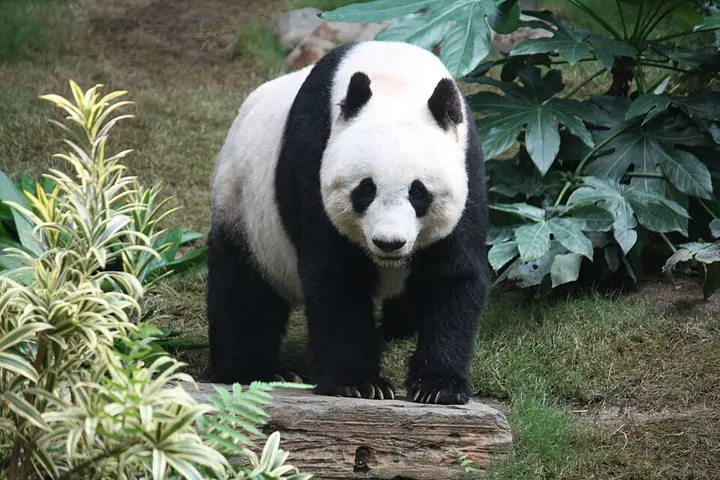
The giant panda, also known as the panda bear or simply panda, is a bear species endemic to China. It is characterised by its white coat with black patches around the eyes, ears, legs and shoulders. Its body is rotund; adult individuals weigh 100 to 115 kg and are typically 1.2 to 1.9 m long.
It is sexually dimorphic, with males being typically 10–20% larger than females. A thumb is visible on its forepaw, which helps in holding bamboo in place for feeding. It has large molar teeth and expanded temporal fossae to meet its dietary requirements. It can digest starch and is mostly herbivorous with a diet consisting almost entirely of bamboo and bamboo shoots. The giant panda lives exclusively in six montane regions in a few Chinese provinces at elevations of up to 3,000 m (9,800 ft). It is solitary and gathers only in mating seasons. It relies on olfactory communication and uses scent marks as chemical cues and on landmarks like rocks or trees. Females rear cubs for an average of 18 to 24 months. The oldest known giant panda was 38 years old.
Appearance
The giant panda has a body shape typical of bears. It has black fur on its ears, limbs, shoulders and around the eyes. The rest of the animal's coat is white. The giant panda's distinctive coloration appears to serve as camouflage in both winter and summer environments as they do not hibernate. The white areas serve as camouflage in snow, while the black shoulders and legs conceal them in shade.
Behaviour
Despite its taxonomic classification as a carnivoran, the giant panda's diet is primarily herbivorous, with approximately 99% of its diet consisting of bamboo. However, the giant panda still has the digestive system of a carnivore, as well as carnivore-specific genes, and thus derives little energy and little protein from the consumption of bamboo.
Diet
Despite its taxonomic classification as a carnivoran, the giant panda's diet is primarily herbivorous, with approximately 99% of its diet consisting of bamboo. However, the giant panda still has the digestive system of a carnivore, as well as carnivore-specific genes, and thus derives little energy and little protein from the consumption of bamboo.
Habitat
The giant panda is endemic to China. It is found in small, fragmented populations in six mountainous regions in the country, mainly in Sichuan, and also in neighbouring Shaanxi and Gansu. Successful habitat preservation has seen a rise in panda numbers, though loss of habitat due to human activities remains its biggest threat.
Where the Giant panda lives
Recorded in China (Asia).
Most records fall in Sichuan, Shaanxi, Guangxi and Gansu.
See the Giant panda’s range on the globe
Conservation status
Vulnerable (VU). At risk: it could become endangered. Categories are the IUCN Red List as republished by GBIF.
Sources
The range is a density of 47 georeferenced GBIF records, shown on the continents where it is mainly recorded, not an expert-drawn map. Description from Wikipedia.