Animals / Mammal
Giant otter
Pteronura brasiliensis · Mustelidae
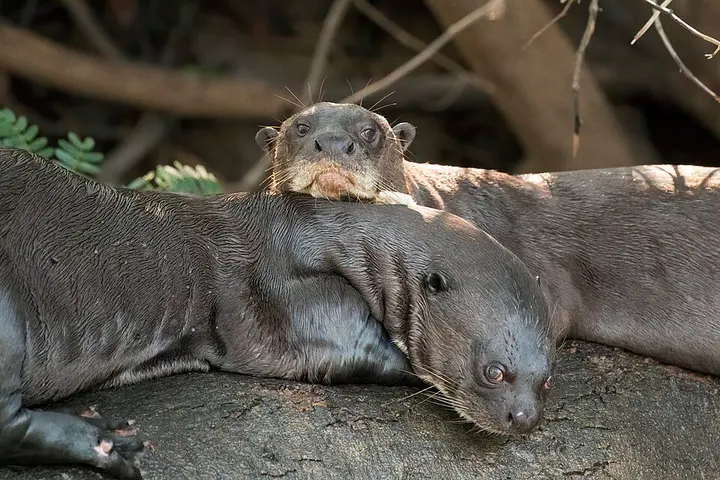
The giant otter or giant river otter is a South American carnivorous mammal. It is the longest member of the weasel family, Mustelidae, reaching up to 1.8 m. Atypical of mustelids, the giant otter is a social species, with family groups typically supporting three to eight members.
The groups are centered on a dominant breeding pair and are extremely cohesive and cooperative. Although generally peaceful, the species is territorial, and aggression has been observed between groups. The giant otter is diurnal, being active exclusively during daylight hours. It is the noisiest otter species, and distinct vocalizations have been documented that indicate alarm, aggression, and reassurance. The giant otter ranges across north-central South America; it lives mostly in and along the Amazon River and in the Pantanal. Its distribution has been greatly reduced and is now discontinuous. Decades of poaching for its velvety pelt, peaking in the 1950s and 1960s, considerably diminished population numbers.
Appearance
The giant otter is clearly distinguished from other otters by morphological and behavioural characteristics. It has the greatest body length of any species in the mustelid family, although the sea otter may be heavier. Males are between 1.5 and 1.7 m (4 ft 11 in and 5 ft 7 in) in length from head to tail and females between 1 and 1.5 m (3 ft 3+1⁄2 in and 4 ft 11 in). The animal's well-muscled tail can add a further 70 cm (28 in) to the total body length.
Behaviour
The giant otter is an especially noisy animal, with a complex repertoire of vocalizations. All otters produce vocalizations, but by frequency and volume, the giant otter may be the most vocal. Duplaix identified nine distinct sounds, with further subdivisions possible, depending on context. Quick hah barks or explosive snorts suggest immediate interest and possible danger.
Habitat
The species is amphibious, although primarily terrestrial. It occurs in freshwater rivers and streams, which generally flood seasonally. Other water habitats include freshwater springs and permanent freshwater lakes. Four specific vegetation types occur on one important creek in Suriname: riverbank high forest, floodable mixed marsh and high swamp forest, floodable low marsh forest, and grass islands and floating meadows within open areas of the creek itself.
Life cycle
Giant otters build dens, which are holes dug into riverbanks, usually with multiple entrances and multiple chambers inside. They give birth within these dens during the dry season. In Cantão State Park, otters dig their reproductive dens on the shores of oxbow lakes starting around July, when waters are already quite low.
Where the Giant otter lives
Recorded in Brazil, Peru, Ecuador, Colombia and Guyana (South America).
Most records fall in Mato Grosso, Mato Grosso do Sul, Madre de Dios, Orellana, Amazonas and Sucumbios.
See the Giant otter’s range on the globe
Conservation status
Endangered (EN). In danger of dying out in the wild. Categories are the IUCN Red List as republished by GBIF.
Sources
The range is a density of 2,143 georeferenced GBIF records, shown on the continents where it is mainly recorded, not an expert-drawn map. Description from Wikipedia.