Animals / Fish
Giant oceanic manta ray
Manta birostris · Myliobatidae
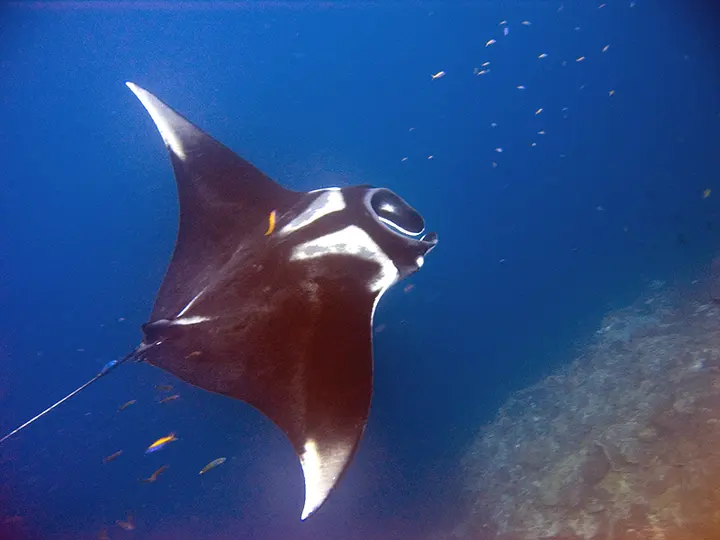
The giant oceanic manta ray, giant manta ray, oceanic manta ray, or pelagic manta ray is a species of ray in the family Mobulidae and the largest type of ray in the world. It is circumglobal and is typically found in tropical and subtropical waters but can also be found in temperate waters. Until 2017, the species was classified in the genus Manta, along with the smaller reef manta ray.
DNA testing revealed that both mantas are closer related to some Mobula species than these are to other Mobula, being claded together. As a result, the two Manta species were absorbed into Mobula to reflect the new classification.
Appearance
The giant oceanic manta ray can grow up to 9 m (30 ft) in length and a disc size of 7 m (23 ft) across, with a weight around 3,000 kg (6,600 lb), but the typical size is 4.5 m (15 ft). It is dorsoventrally flattened and has large, triangular pectoral fins on either side of the disc. At the front, it has a pair of cephalic fins, which are forward extensions of the pectoral fins.
Habitat
The giant oceanic manta ray has a widespread distribution in tropical and temperate waters worldwide. In the Northern Hemisphere, it has been recorded as far north as southern California and New Jersey in the United States, Aomori Prefecture in Japan, the Sinai Peninsula in Egypt, and the Azores in the northern Atlantic. In the Southern Hemisphere, it occurs as far south as Peru, Uruguay, South Africa, and New Zealand.
Life cycle
Males become sexually mature when their disc width is about 4 m (13 ft), while females need to be about 5 m (16 ft) wide to breed. When a female is becoming receptive, one or several males may swim along behind her in a "train". During copulation, one of the males grips the female's pectoral fin with his teeth and they continue to swim with their ventral surfaces in contact. He inserts his claspers into her cloaca, and these form a tube through which the sperm is pumped.
Where the Giant oceanic manta ray lives
Recorded in Ecuador, United States of America, Mexico, Peru, Fr. Polynesia, Indonesia, New Zealand and New Caledonia (South America, North America, Oceania and Asia).
Most records fall in Florida, Manabi, Santa Elena, Tumbes, Galápagos and Baja California Sur.
See the Giant oceanic manta ray’s range on the globe
Conservation status
Endangered (EN). In danger of dying out in the wild. Categories are the IUCN Red List as republished by GBIF.
Sources
The range is a density of 4,477 georeferenced GBIF records, shown on the continents where it is mainly recorded, not an expert-drawn map. Description from Wikipedia.