Animals / Mammal
Giant anteater
Myrmecophaga tridactyla · Myrmecophagidae
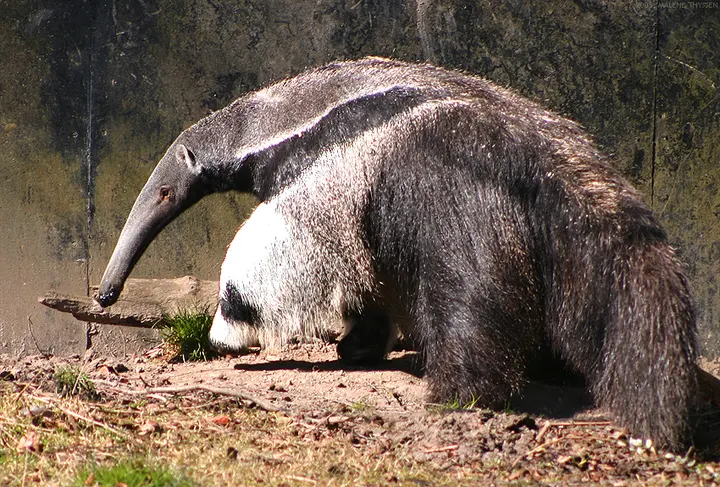
The giant anteater is a large insectivorous mammal native to Central and South America. It is the largest of the four living species of anteaters, which are classified with sloths in the order Pilosa. The only extant member of the genus Myrmecophaga, the giant anteater is mostly terrestrial, in contrast to other living anteaters and sloths, which are arboreal or semiarboreal.
It is recognizable by its elongated snout, bushy tail, long foreclaws, and distinctively colored fur. The giant anteater is found in multiple habitats, including grassland and rainforest. It forages in open areas and rests in more forested habitats. It feeds primarily on ants and termites, using its foreclaws to dig them up and its long, sticky tongue to collect them. Though giant anteaters live in overlapping home ranges, they are mostly solitary except during mother-offspring relationships, aggressive interactions between males, and when mating. Mother anteaters carry their offspring on their backs until weaning them. The giant anteater is listed as vulnerable by the International Union for Conservation of Nature. It has been extirpated from many parts of its former range.
Appearance
The giant anteater can be identified by its large size, long, narrow muzzle, and long, bushy tail. It has a total body length of 182 to 217 cm (72 to 85 in). Males weigh 33 to 50 kg (73 to 110 lb), and females weigh 27 to 47 kg (60 to 104 lb), making the giant anteater the biggest extant species in its suborder. The head of the giant anteater, at 30 cm (12 in) long, is particularly elongated, even when compared to other anteaters.
Behaviour
Despite its iconic status, the giant anteater is little studied in the wild, and research has been limited to certain areas. The species may use multiple habitats; a 2007 study of giant anteaters in the Brazilian Pantanal found that the animals move and forage in open areas and rest in forests; the latter provide shade when the temperature rises and retain heat when the temperature drops. Anteaters may travel an average of 3,700 m (12,100 ft) per day.
Diet
This animal is an insectivore, and feeds mostly on ants or termites (myrmecophagy). In areas that experience regular flooding, like the Pantanal and the Venezuelan-Colombian Llanos, anteaters mainly feed on ants, which are more numerous. Conversely, termites are more numerous in the grasslands of Emas National Park and hence are a more important food source for anteaters there.
Where the Giant anteater lives
Recorded in Colombia, Brazil and Argentina (South America).
Most records fall in Meta, Casanare, Mato Grosso do Sul, São Paulo, Minas Gerais and Goiás.
See the Giant anteater’s range on the globe
Conservation status
Vulnerable (VU). At risk: it could become endangered. Categories are the IUCN Red List as republished by GBIF.
Sources
The range is a density of 10,733 georeferenced GBIF records, shown on the continents where it is mainly recorded, not an expert-drawn map. Description from Wikipedia.