Animals / Reptile
Gharial
Gavialis gangeticus · Gavialidae
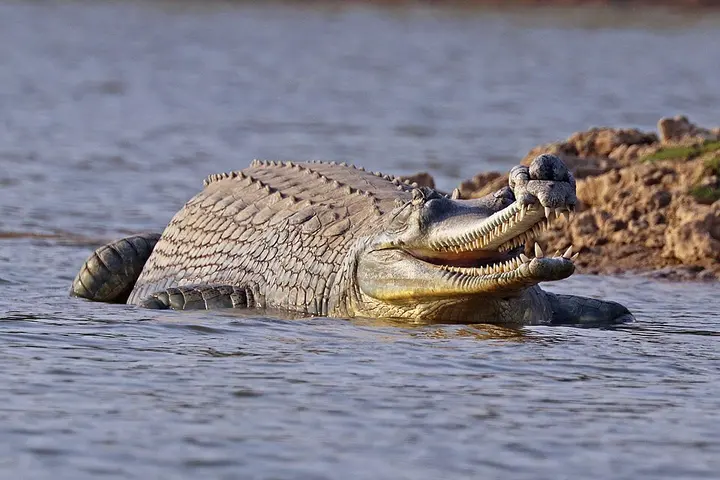
The gharial, also known as gavial or fish-eating crocodile, is a crocodilian in the family Gavialidae and among the longest of all living crocodilians. Mature females are 2.6 to 4.5 m long, and males 3 to 6 m. Adult males have a distinct boss at the end of the snout, which resembles an earthenware pot known as a ghara, hence the name "gharial".
The gharial is well adapted to catching fish because of its long, narrow snout and 110 sharp, interlocking teeth. The gharial probably evolved in the northern Indian subcontinent. Fossil gharial remains were excavated in Pliocene deposits in the Sivalik Hills and the Narmada River valley. It currently inhabits rivers in the plains of the northern part of the Indian subcontinent. It is the most thoroughly aquatic crocodilian, and leaves the water only for basking and building nests on moist sandbanks. Adults mate at the end of the cold season. Females congregate in spring to dig nests, in which they lay 20–95 eggs. They guard the nests and the young, which hatch before the onset of the monsoon.
Appearance
The gharial is olive-coloured, with adults being darker than young, which have dark brown cross bands and speckles. Its back turns almost black at 20 years of age, but its belly is yellowish-white. It has four transverse rows of two scales on the neck, which continue along the back. Scutes on the head, neck and back form a single continuous plate composed of 21 to 22 transverse series, and four longitudinal series.
Behaviour
The gharial is the most thoroughly aquatic crocodilian. It leaves the water only for basking on riverbanks. Being cold-blooded, it seeks to cool down during hot times and to warm up when ambient temperature is cool. Gharials bask daily in the cold season, foremost in the mornings, and prefer sandy and moist beaches.
Diet
The gharial is well adapted to hunting fish underwater because of its sharp interlocking teeth and long narrow snout, which meets little resistance in the water. It does not chew its prey, but swallows it whole. Juvenile gharials were observed to jerk their heads back to manoeuvre fish into their gullets, sliding them in head first. Young gharials feed on insects, tadpoles, small fish and frogs. Adults also feed on small crustaceans.
Habitat
The gharial once thrived in all the major river systems of the northern Indian subcontinent, from the Indus River in Pakistan, the Ganges in India, the Brahmaputra River in northeastern India and Bangladesh to the Irrawaddy River in Myanmar. In the early 20th century, it was considered common in the Indus River and its Punjabi tributaries. By the early 1980s, it was almost extinct in the Indus. During surveys in 2008 and 2009, no gharial was sighted in the river.
Where the Gharial lives
Recorded in India and Nepal (Asia).
Most records fall in Narayani, Madhya Pradesh, Rajasthan, Uttar Pradesh, Uttarakhand and Bheri.
See the Gharial’s range on the globe
Conservation status
Critically endangered (CR). In very great danger of dying out in the wild. Categories are the IUCN Red List as republished by GBIF.
Sources
The range is a density of 951 georeferenced GBIF records, shown on the continents where it is mainly recorded, not an expert-drawn map. Description from Wikipedia.