Animals / Mammal
Gerenuk
Litocranius walleri · Bovidae
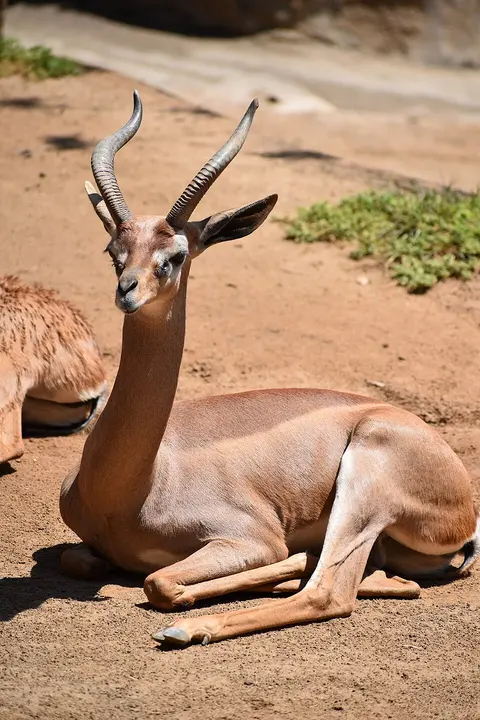
The gerenuk, also known as the giraffe gazelle, is a long-necked, medium-sized antelope found mainly in the Somali region of East Africa. The sole member of the genus Litocranius, the gerenuk was first described by the naturalist Victor Brooke in 1879. It is characterised by its long, slender neck and limbs.
The antelope is 80–105 centimetres (2 feet 7 inches – 3 feet 5 inches) tall, and weighs between 18 and 52 kilograms (40 and 115 pounds). Two types of colouration are clearly visible on the smooth coat: the reddish brown back or the "saddle", and the lighter flanks, fawn to buff. The horns, present only on males, are lyre-shaped. Curving backward then slightly forward, these measure 25–44 cm (10–17+1⁄2 in).
Appearance
The gerenuk is a notably tall, slender antelope that resembles gazelles. It is characterised by its long, slender neck and limbs, the flat, wedge-like head and the large, round eyes. Males are nearly 89–105 cm (35–41+1⁄2 in) tall, and the shorter females 80–100 cm (31–39 in); the head-and-body length is typically between 140 and 160 cm (55 and 63 in). Males weigh between 31 and 52 kg (68 and 115 lb); females are lighter, weighing 28–45 kg (62–99 lb).
Behaviour
The gerenuk is a diurnal animal (active mainly during the day), though it typically stands or rests in shade during the noon. Foraging and feeding is the major activity throughout the day; females appear to spend more time feeding. The gerenuk may expose itself to rain, probably to cool its body. The social structure consists of small herds of two to six members. Herds typically comprise members of a single sex, though female herds additionally have juveniles.
Diet
Primarily a browser, the gerenuk feed on foliage of bushes as well as trees, shoots, herbs, flowers and fruits. It can reach higher branches and twigs better than other gazelles and antelopes by standing erect on its hindlegs and elongating its neck; this helps it reach over 2 m (6 ft 7 in) above the ground. Acacia species are eaten whenever available, while evergreen vegetation forms the diet during droughts.
Life cycle
Gerenuk reproduce throughout the year. Females reach sexual maturity at around one year, and males reach sexual maturity at 1.5 years, although in the wild they may only be successful after acquiring a territory (perhaps 3.5 years). The gestation period is about seven months. They are born one at a time, weighing about 3 kg (7 lb) at birth. Offspring were produced through artificial insemination for the first time in 2010 at White Oak Conservation in Yulee, Florida.
Where the Gerenuk lives
Recorded in Kenya, Ethiopia, Somalia and Tanzania (Africa).
Most records fall in Eastern, Rift Valley, Coast, Oromiya, Afar and Arusha.
See the Gerenuk’s range on the globe
Conservation status
Near threatened (NT). Not at risk yet, but could be soon. Categories are the IUCN Red List as republished by GBIF.
Sources
The range is a density of 1,154 georeferenced GBIF records, shown on the continents where it is mainly recorded, not an expert-drawn map. Description from Wikipedia.