Animals / Mammal
Geoffroy's spider monkey
Ateles geoffroyi · Atelidae
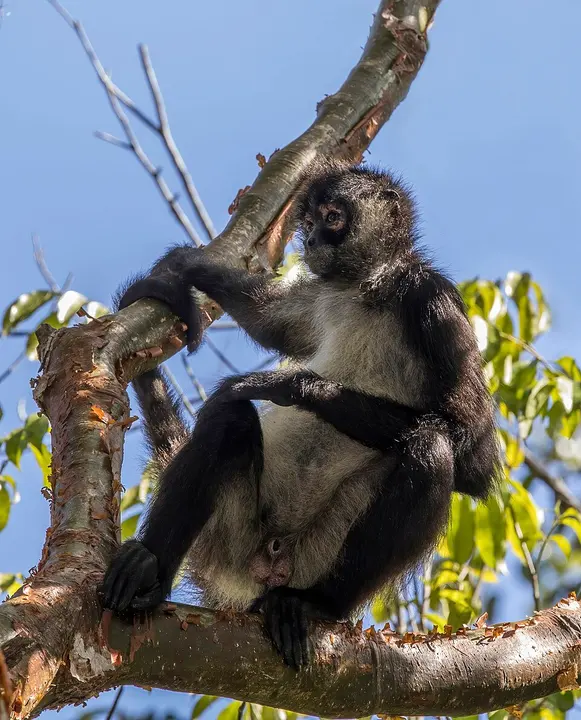
Geoffroy's spider monkey, also known as the black-handed spider monkey or the Central American spider monkey, is a species of spider monkey, a type of New World monkey, from Central America, parts of Mexico and possibly a small portion of Colombia. There are at least five subspecies. Some primatologists classify the black-headed spider monkey (A. fusciceps), found in Panama, Colombia, and Ecuador as the same species as Geoffroy's spider monkey.
It is one of the largest New World monkeys, often weighing as much as 9 kg (20 lb). Its arms are significantly longer than its legs, and its prehensile tail can support the entire weight of the monkey and is used as an extra limb. Its hands have only a vestigial thumb, but long, strong, hook-like fingers. These adaptations allow the monkey to move by swinging by its arms beneath the tree branches. Geoffroy's spider monkey lives in fission–fusion societies that contain between 20 and 42 members. Its diet consists primarily of ripe fruit and it requires large tracts of forest to survive. As a result of habitat loss, hunting and capture for the pet trade, it is considered to be endangered by the IUCN.
Appearance
Geoffroy's spider monkey is one of the largest New World monkeys. Its length measures between 30 and 63 cm (12 and 25 in) and it weighs between 6 and 9 kg (13 and 20 lb). The tail is longer than the body at between 63 and 85 cm (25 and 33+1⁄2 in). Males and females are approximately the same size. Its body color varies by subspecies and population, and can be buff, reddish, rust, brown or black. The hands and feet are dark or black.
Behaviour
Geoffroy's spider monkey is arboreal and diurnal, and mostly inhabits the upper portion of the forest. However, it comes to the ground more frequently than other spider monkey species. It lives in fission–fusion societies, large groups with a typical 20 to 42 members, which split into smaller subgroups to forage during the day. Subgroups typically number two to six members, and sometimes the subgroups remain separate from the main group even through the night.
Diet
Geoffroy's spider monkey eats mostly fruit – preferably ripe and fleshy – and spends 70–80% of its feeding time eating fruit. Leaves make up most of the rest of its diet. Young leaves are especially important to provide the protein that can be lacking in fruit. Other elements of its diet include flowers, bark, insects, honey, seeds and buds. In addition to providing much of the monkey's nutritional needs, fruit and leaves provide much of its water requirements.
Habitat
The range of this species extends over much of Central America, encompassing Panama, Costa Rica, Nicaragua, Guatemala, Honduras, El Salvador, Belize and the south and much of the eastern portion of Mexico. Observations by local people indicate the southernmost subspecies, the hooded spider monkey, A. g. grisescens, may also occur in the portion of Colombia near the Panama border.
Where the Geoffroy's spider monkey lives
Recorded in Mexico, Costa Rica, Guatemala, Belize and Nicaragua (North America).
Most records fall in Oaxaca, Puntarenas, Quintana Roo, Limón, Petén and Alajuela.
See the Geoffroy's spider monkey’s range on the globe
Conservation status
Endangered (EN). In danger of dying out in the wild. Categories are the IUCN Red List as republished by GBIF.
Sources
The range is a density of 10,085 georeferenced GBIF records, shown on the continents where it is mainly recorded, not an expert-drawn map. Description from Wikipedia.