Animals / Mammal
Gemsbok
Oryx gazella · Bovidae
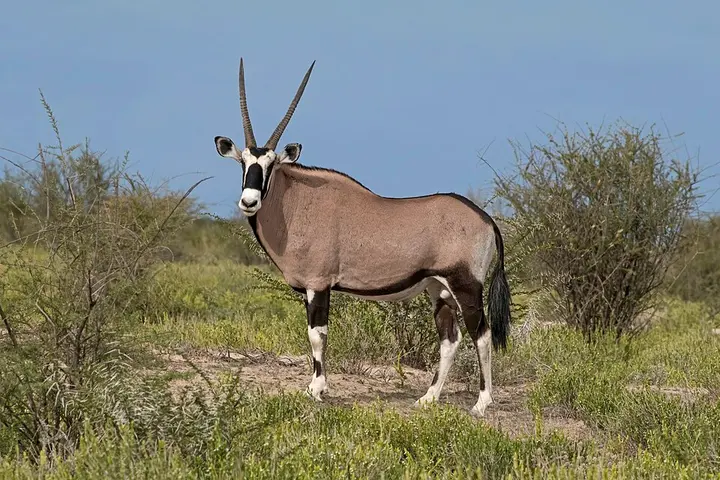
The gemsbok, or South African oryx, is a large antelope in the genus Oryx. It is endemic to the dry and barren regions of Botswana, Namibia, South Africa and Zimbabwe, mainly inhabiting the Kalahari and Namib Deserts, areas in which it is supremely adapted for survival. Previously, some sources classified the related East African oryx, or beisa oryx, as a subspecies.
Appearance
Gemsbok are light taupe to tan in color, with lighter patches toward the bottom rear of the rump. Their tails are long and black in color. A blackish stripe extends from the chin down the lower edge of the neck, through the juncture of the shoulder and leg along the lower flank of each side to the blackish section of the rear leg.
Diet
The gemsbok is generally a grazer but changes to browsing during the dry season or when grass is sparse. It may dig up to a meter deep to find roots and tubers, supplementing its water intake by eating wild tsamma melons and cucumbers, which can provide all the water required (3 liters per 100 kg bodyweight a day).
Habitat
Gemsbok are found in arid and semi-arid bushlands in southwestern Africa, especially around the Namib and Kalahari deserts, in Botswana, Zimbabwe, Namibia, South Africa and formerly Angola (where they are considered extirpated). A sizeable introduced population of several thousand is also present in the Chihuahuan Desert in Southern New Mexico at the White Sands Missile Range where they are problematic for the local ecosystem.
Life cycle
The gemsbok is polygynous, with one resident male mating with the receptive females in the herd. The male is known to secure exclusive mating access to the females by attempting to herd mixed or nursery herds onto his territory. The gemsbok has no specified breeding season, but the young in a given herd tend to be of a similar age due to reproductive synchrony between females. Pregnant females leave the herd before giving birth.
Where the Gemsbok lives
Recorded in Namibia, South Africa, United States of America and Botswana (Africa and North America).
Most records fall in Northern Cape, Oshikoto, Hardap, New Mexico, Western Cape and Karas.
See the Gemsbok’s range on the globe
Conservation status
Least concern (LC). Not at risk: it is doing well in the wild. Categories are the IUCN Red List as republished by GBIF.
Sources
The range is a density of 5,878 georeferenced GBIF records, shown on the continents where it is mainly recorded, not an expert-drawn map. Description from Wikipedia.