Animals / Mammal
Gelada
Theropithecus gelada · Cercopithecidae
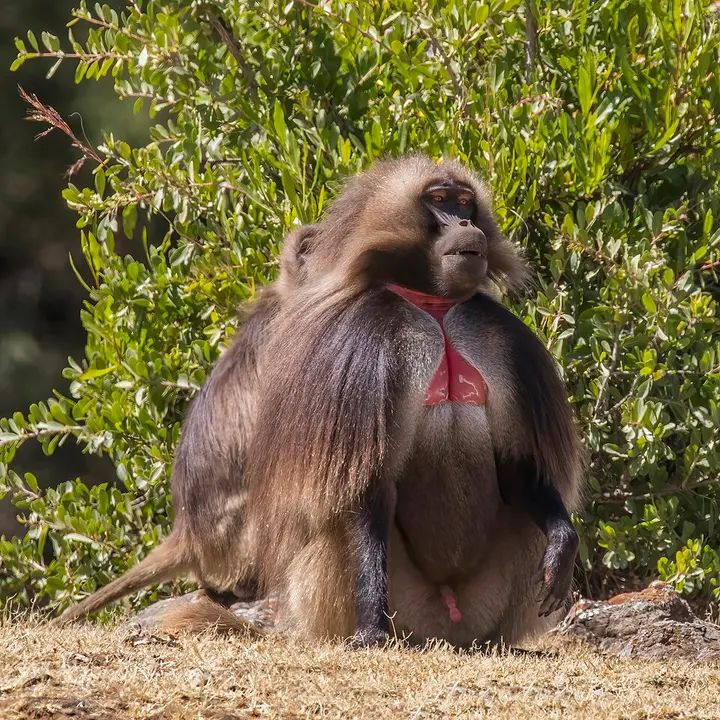
The gelada, sometimes called the bleeding-heart monkey or the gelada baboon, is a species of Old World monkey found only in the Ethiopian Highlands, living at elevations of 1,800–4,400 m (5,900–14,400 ft) above sea level. It is the only living member of the genus Theropithecus, a name derived from the Greek root words for "beast-ape". Like its close relatives in genus Papio, the baboons, it is largely terrestrial, spending much of its time foraging in grasslands, with grasses comprising up to 90% of its diet.
It has buff to dark brown hair with a dark face and pale eyelids. Adult males have longer hair on their backs and a conspicuous bright red patch of skin shaped like an hourglass on their chests. Females also have a bare patch of skin but it is less pronounced, except during estrus, when it brightens and exhibits a "necklace" of fluid-filled blisters. Males average 18.5 kg (41 lb) and females average 11 kg (24 lb) in weight. The head-body length is 50–75 cm (20–30 in) with a tail of 30–50 cm (12–20 in). The gelada has a complex multilevel social structure. Reproductive units and male units are the two basic groupings. A band comprises a mix of multiple reproductive units and male units; a community is made up of one to four bands.
Appearance
The gelada is large and robust, and it is covered with buff to dark-brown, coarse hair and has a dark face with pale eyelids. Its arms and feet are nearly black. Its short tail ends in a tuft of hair. Adult males have a long, heavy cape of hair on their backs. The gelada has a hairless face with a short muzzle that looks more similar to a chimpanzee's than a baboon's. It can also be physically distinguished from a baboon by the bright patch of skin on its chest.
Behaviour
Geladas live in a complex, multilevel society similar to that of the hamadryas baboon. The smallest and most basic groups are the reproductive units, which include up to 12 females, their young, and one to four males, and the all-male units, which are made up of 2–15 males. The next level of gelada societies are the bands, which are made up of two to 27 reproductive units and several all-male units.
Where the Gelada lives
Recorded in Ethiopia (Africa).
Most records fall in Amhara, Oromiya, Southern Nations, Nationalities and Peoples and Tigray.
See the Gelada’s range on the globe
Conservation status
Least concern (LC). Not at risk: it is doing well in the wild. Categories are the IUCN Red List as republished by GBIF.
Sources
The range is a density of 381 georeferenced GBIF records, shown on the continents where it is mainly recorded, not an expert-drawn map. Description from Wikipedia.