Animals / Mollusc
Garden snail
Cornu aspersum · Helicidae
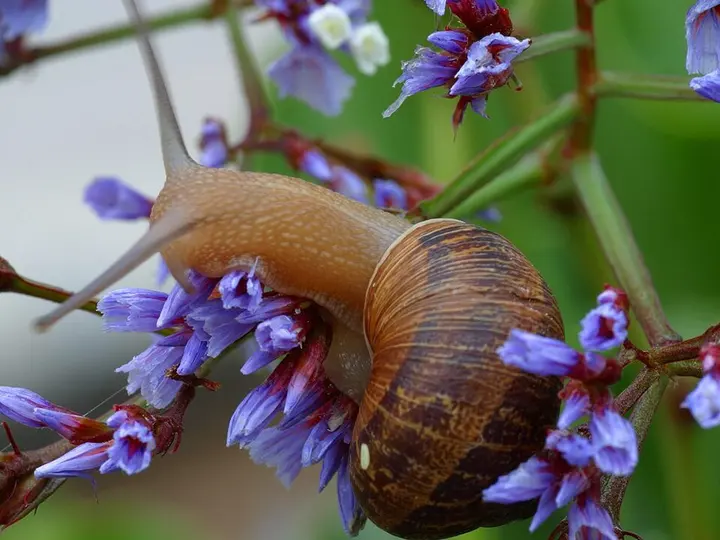
Cornu aspersum, known by the common name garden snail, is a species of land snail in the family Helicidae, which includes some of the most familiar land snails. Of all terrestrial molluscs, this species may be the most widely known. It was classified under the name Helix aspersa for over two centuries, but the prevailing classification now places it in the genus Cornu.
It was classified under the name Helix aspersa for over two centuries, but the prevailing classification now places it in the genus Cornu. The garden snail is relished as a food item in some areas, but it is also widely regarded as a pest in gardens and in agriculture, especially in regions where it has been introduced accidentally, and where snails are not usually considered to be a menu item.
Appearance
The adult bears a hard, thin calcareous shell 25–40 millimetres (1–1+5⁄8 in) in diameter and 25–35 millimetres (1–1+3⁄8 in) high, with four or five whorls. The shell is variable in coloring and shade of color, but generally it has a reticulated pattern of dark brown, brownish-golden, or chestnut with yellow stripes, flecks, or streaks (characteristically interrupted brown colour bands).
Behaviour
Cornu aspersum is a primarily a herbivore. It feeds on numerous types of fruit trees, vegetable crops, rose bushes, garden flowers, and cereals. It also is an omnivorous scavenger that will feed on rotting plant material and on occasion scavenge animal matter, such as crushed snails and worms. Cornu aspersum can obtain the calcium required to build its shell by consuming soil.
Habitat
Cornu aspersum is native to the Mediterranean region and its present range stretches from northwest Africa and Iberia, eastwards to Asia Minor and Egypt, and northwards to Britain. Cornu aspersum is a typically anthropochorous species; it has been spread to many geographical regions by humans, either deliberately or accidentally.
Life cycle
Like other Pulmonata, individuals are hermaphrodites, producing both male and female gametes. Reproduction is predominantly, and probably exclusively, by outcrossing. During a mating session of several hours, two snails exchange sperm reciprocally. H. aspersa snails stab a calcite spine, known as a love dart, into their partner. The mucus coating the love dart contains a chemical that diverts sperm away from being digested.
Where the Garden snail lives
Recorded in Netherlands, United Kingdom, Germany, France, Spain, Portugal and Italy (Europe, North America and Oceania).
Introduced, not native, in United States of America, Ashmore and Cartier Is. and Mexico.
Most records fall in California, Zuid-Holland, Nordrhein-Westfalen, Noord-Holland, Gelderland and Noord-Brabant.
See the Garden snail’s range on the globe
Conservation status
Not evaluated (NE). Scientists haven’t checked yet how at risk it is, so this doesn’t mean it is safe or in danger. Categories are the IUCN Red List as republished by GBIF.
Sources
The range is a density of 258,421 georeferenced GBIF records, shown on the continents where it is mainly recorded, not an expert-drawn map. Description from Wikipedia.