Animals / Reptile
Galápagos tortoise
Chelonoidis niger · Testudinidae
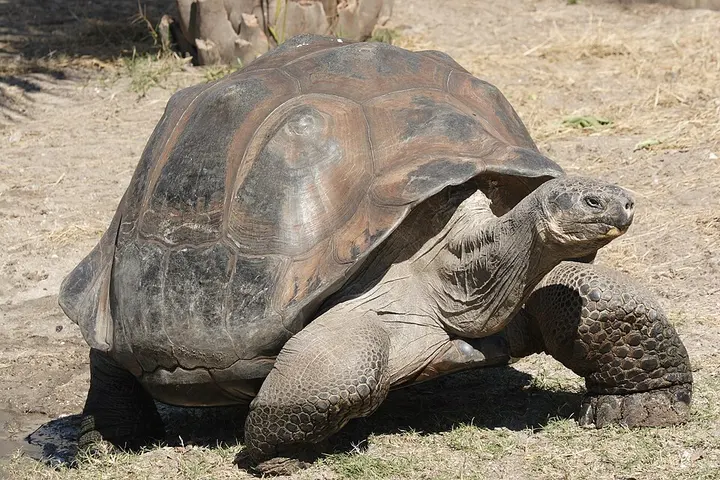
The Galápagos tortoise, also called the Galápagos giant tortoise, is a very large species of tortoise in the genus Chelonoidis. The species comprises 15 subspecies. It is the largest living species of tortoise, and can weigh up to 417 kg (919 lb).
They are also the largest extant terrestrial cold-blooded animals (ectotherms). With lifespans in the wild of over 100 years, it is one of the longest-lived vertebrates. Captive Galapagos tortoises can live up to 177 years. For example, a captive individual, Harriet, lived for at least 175 years. Spanish explorers, who discovered the islands in the 16th century, named them after the Spanish galápago, meaning "tortoise". Galápagos tortoises are native to seven of the Galápagos Islands. Shell size and shape vary between subspecies and populations.
Appearance
The tortoises have a large bony shell of a dull brown or grey color. The plates of the shell are fused with the ribs in a rigid protective structure that is integral to the skeleton. Lichens can grow on the shells of these slow-moving animals. Tortoises keep a characteristic scute (shell segment) pattern on their shells throughout life, though the annual growth bands are not useful for determining age because the outer layers are worn off with time.
Behaviour
The tortoises are ectothermic (cold-blooded), so they bask for 1–2 hours after dawn to absorb the sun's heat through their dark shells before actively foraging for 8–9 hours a day. They travel mostly in the early morning or late afternoon between resting and grazing areas. They have been observed to walk at a speed of 0.3 km/h (0.2 mph).
Diet
The tortoises are herbivores that consume a diet of cacti, grasses, forbs, leaves, lichens, berries, melons, oranges, milkweed and stinging nettle. They have been documented feeding on Hippomane mancinella (poison apple), the endemic guava Psidium galapageium, the water fern Azolla microphylla, bromeliad Tillandsia insularis and the Galápagos tomato Solanum cheesmaniae.
Life cycle
Mating occurs at any time of the year, although it does have seasonal peaks between February and June in the humid uplands during the rainy season. When mature males meet in the mating season, they face each other in a ritualised dominance display, rise up on their legs, and stretch up their necks with their mouths gaping open. Occasionally, head-biting occurs, but usually the shorter tortoise backs off, conceding mating rights to the victor.
Where the Galápagos tortoise lives
Recorded in Ecuador (South America).
Most records fall in Galápagos.
See the Galápagos tortoise’s range on the globe
Conservation status
Varies by species (VAR). It is a group of related animals, and each kind is rated on its own, from vulnerable to critically endangered. Categories are the IUCN Red List as republished by GBIF.
Sources
The range is a density of 1,719 georeferenced GBIF records, shown on the continents where it is mainly recorded, not an expert-drawn map. Description from Wikipedia.