Animals / Mammal
Four-toed hedgehog
Atelerix albiventris · Erinaceidae
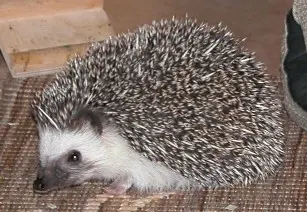
The four-toed hedgehog, also known as the African pygmy hedgehog, is a species of hedgehog found throughout much of central and eastern Africa.
Populations tend to be scattered between suitable savannah or cropland habitats, avoiding forested areas. The species common name is derived from the number of toes found on its hind feet. Due to its extensive range and stable wild population, the species is rated as least concern by the IUCN. In addition, the species is a popular small pet in various countries, and has been successfully domesticated and bred in captivity. There are no universally agreed subspecies of A. albiventris.
Appearance
The four-toed hedgehog is an oval bodied animal approximately 210 millimetres (8.3 in) in length and weighing between 250 and 600 grams (8.8 and 21.2 oz). Females are typically larger than males. It has short legs, short tail typically around 2.5 centimetres (0.98 in) in length, a long nose, and small beady eyes. The ears and whiskers are both relatively large, implying that the animal has good senses.
Behaviour
The four-toed hedgehog is a solitary, nocturnal animal. It generally moves along the ground, but is capable of both climbing and swimming when the need arises. It is highly energetic, sometimes covering miles of ground in a single night as it forages for insects, grubs, snails, spiders, some plant matter, and even small vertebrates. It has a high tolerance for toxins and has been recorded consuming scorpions and even venomous snakes.
Habitat
The four-toed hedgehog is found across a wide swathe of central Africa, from Gambia and Senegal in the west, to Somalia in the east, and also in eastern Africa, as far south as Mozambique. It prefers grassy environments or open woodland, and is found at elevations as high as 2,000 metres (6,600 ft), although it is more common in lowland areas. Because it prefers to shelter in dry rocky or grassy areas, it avoids dense forest and swampland.
Life cycle
Female four-toed hedgehogs do not go into estrus during any particular season, and are fertile throughout the year, although mating is most common during the rainy season, when food is most abundant. The female typically gives birth to a single litter each year, which may contain from two to ten hoglets, with four or five being most typical. Males approach the female and court her with high pitched vocalizations.
Where the Four-toed hedgehog lives
Recorded in Kenya, Benin, Senegal, Tanzania, Burkina Faso, Malawi, Nigeria, Togo, Ghana, Mali, Niger, Dem. Rep. Congo and S. Sudan (Africa).
Most records fall in Coast, Lilongwe, Matam, Savanes, Arusha and Rift Valley.
See the Four-toed hedgehog’s range on the globe
Conservation status
Least concern (LC). Not at risk: it is doing well in the wild. Categories are the IUCN Red List as republished by GBIF.
Sources
The range is a density of 807 georeferenced GBIF records, shown on the continents where it is mainly recorded, not an expert-drawn map. Description from Wikipedia.