Animals / Bird
Fischer's lovebird
Agapornis fischeri · Psittacidae
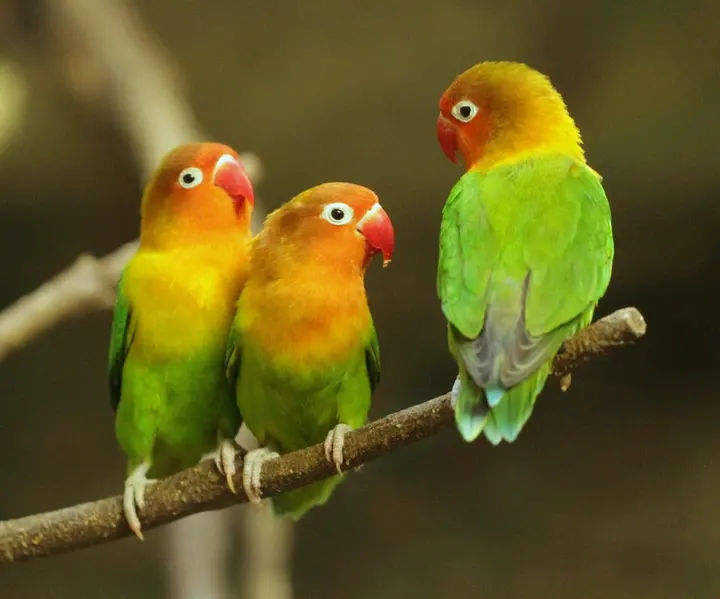
Fischer's lovebird is a small parrot species of the genus Agapornis. They were originally discovered in the late 19th century. They are named after the 19th century German explorer of East Africa Gustav Fischer.
Appearance
The Fischer's lovebird has a green back, chest, and wings. Their necks are a golden yellow and as it progresses upward it becomes darker orange. The top of the head is olive green, and the beak is bright red. The upper surface of the tail has some purple or blue feathers. It has a white circle of bare skin (eye-ring) around its eyes. Young birds are very similar to the adults, except for the fact that they are duller and the base of their mandible has brown markings.
Behaviour
Fischer's lovebirds can fly fast, and the sound of their wings flapping as they fly can be heard. Like all Lovebirds, they are very vocal and when they do make noise they have a high-pitched chirp.
Habitat
Fischer's lovebird are native to a small area of east-central Africa, south and southeast of Lake Victoria in northern Tanzania. In drought years, some birds move west into Rwanda and Burundi seeking moister conditions. They live at elevations of 1,100-2,200m (3,600-7,200 ft) in small flocks. They live in isolated clumps of trees with grass plains between them.
Life cycle
Fischer's lovebirds, like other lovebirds in the genus Agapornis, mate for life. The term lovebird arose from the strong bonds that mates make with one another. When separated, the physical health of each individual will suffer. Mates like to be in physical contact as much as possible. The breeding season is January through April and June through July. The nest is in a hole in a tree 2 to 15 metres above the ground.
Where the Fischer's lovebird lives
Recorded in Tanzania and Kenya (Africa).
Most records fall in Arusha, Mara, Simiyu, Rift Valley, Manyara and Eastern.
See the Fischer's lovebird’s range on the globe
Conservation status
Near threatened (NT). Not at risk yet, but could be soon. Categories are the IUCN Red List as republished by GBIF.
Sources
The range is a density of 10,102 georeferenced GBIF records, shown on the continents where it is mainly recorded, not an expert-drawn map. Description from Wikipedia.