Animals / Insect
Field cricket
Gryllus campestris · Gryllidae
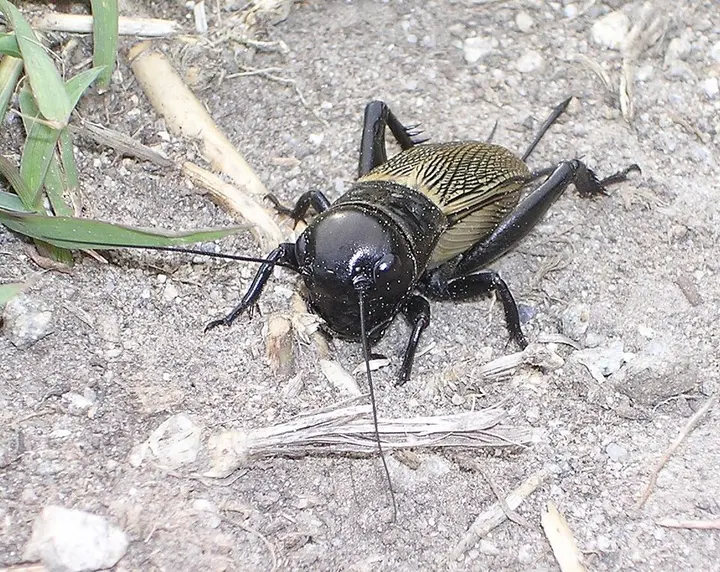
Gryllus campestris, the European field cricket or simply the field cricket in the British Isles, is the type species of crickets in its genus and tribe Gryllini. These flightless dark colored insects are comparatively large; the males range from 19 to 23 mm and the females from 17 to 22 mm.
Habitat
Gryllus campestris used to be common over most of Western Europe. It prefers dry, sunny locations with short vegetation, like dry grasslands. At the northern edge of its range, it is restricted to heathlands and oligotrophic grasslands. The species is flightless and unable to migrate long distances, and it therefore does not commonly recover on its own from local extinction.
Life cycle
The reproductive season of the univoltine species lasts from May to July. The males make a burrow with a platform at the entrance from which they attract females with their courtship stridulation. They chirp during daytime as well as the first part of the night, only when the temperature is well above 13 °C (55 °F). Nymphs hatch in June till mid July and hibernate during their tenth or eleventh instar.
Where the Field cricket lives
Recorded in Switzerland, France, Germany, Netherlands, Austria and Belgium (Europe).
Most records fall in Lucerne, Bern, Vaud, Haute-Savoie, Baden-Württemberg and Solothurn.
See the Field cricket’s range on the globe
Conservation status
Not evaluated (NE). Scientists haven’t checked yet how at risk it is, so this doesn’t mean it is safe or in danger. Categories are the IUCN Red List as republished by GBIF.
Sources
The range is a density of 227,336 georeferenced GBIF records, shown on the continents where it is mainly recorded, not an expert-drawn map. Description from Wikipedia.