Animals / Mammal
Fennec fox
Vulpes zerda · Canidae
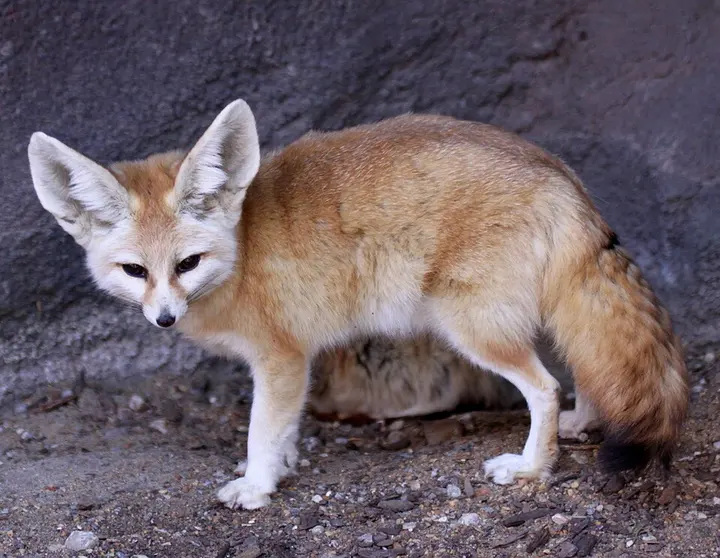
The fennec fox is a small fox native to the deserts of North Africa, ranging from Western Sahara and Mauritania to the Sinai Peninsula. Its most distinctive feature is its unusually large ears, which serve to dissipate heat and listen for underground prey. The fennec is the smallest fox species.
Its coat, ears, and kidney functions have adapted to the desert environment with high temperatures and little water. The fennec fox mainly eats insects, small mammals and birds. It has a life span of up to 14 years in captivity and about 10 years in the wild. Pups are preyed upon by the Pharaoh eagle-owl; both adults and pups may fall prey to jackals and striped hyenas. Fennec families dig out burrows in the sand for habitation and protection, which can be as large as 120 m2 (1,300 sq ft) and adjoin the burrows of other families. Precise population figures are not known but are estimated from the frequency of sightings; these indicate that the fennec fox is currently not threatened by extinction. Knowledge of social interactions is limited to information gathered from captive animals.
Appearance
The fennec fox has sand-colored fur which reflects sunlight during the day and helps keep it warm at night. Its nose is black and its tapering tail has a black tip. Its long ears have longitudinal reddish stripes on the back and are so densely haired inside that the external auditory meatus is not visible. The edges of the ears are whitish, but darker on the back.
Behaviour
Fennec foxes are primarily nocturnal, displaying heightened activity during the cooler nighttime hours. This behaviour helps them escape the extreme Saharan heat and reduces water loss through panting. A fennec fox digs its den in sand, either in open areas or places sheltered by plants with stable sand dunes. In compacted soils, dens are up to 120 m2 (1,300 sq ft) large, with up to 15 different entrances.
Habitat
The fennec fox is distributed throughout the Sahara, from Morocco and Mauritania to northern Sudan, through Egypt and its Sinai Peninsula. It inhabits small sand dunes and vast treeless sand areas with sparse vegetation such as grasses, sedges and small shrubs. In the northern part of its range annual rainfalls have been recorded at <100 mm compared to 300 mm in its southern range.
Life cycle
Fennec foxes mate for life. Captive animals reach sexual maturity at around nine months and mate between January and April. Female fennec foxes are in estrus for an average of 24 hours and usually breed once per year; the copulation tie lasts up to two hours and 45 minutes. Gestation usually lasts between 50 and 52 days, though sometimes up to 63 days.
Where the Fennec fox lives
Recorded in Egypt, Morocco, W. Sahara, Mauritania, Israel and Algeria (Africa and Asia).
Most records fall in Meknès - Tafilalet, Al Jizah, Al Minufiyah, HaDarom, Matruh and Oued el Dahab.
See the Fennec fox’s range on the globe
Conservation status
Least concern (LC). Not at risk: it is doing well in the wild. Categories are the IUCN Red List as republished by GBIF.
Sources
The range is a density of 454 georeferenced GBIF records, shown on the continents where it is mainly recorded, not an expert-drawn map. Description from Wikipedia.