Animals / Bird
European robin
Erithacus rubecula · Muscicapidae
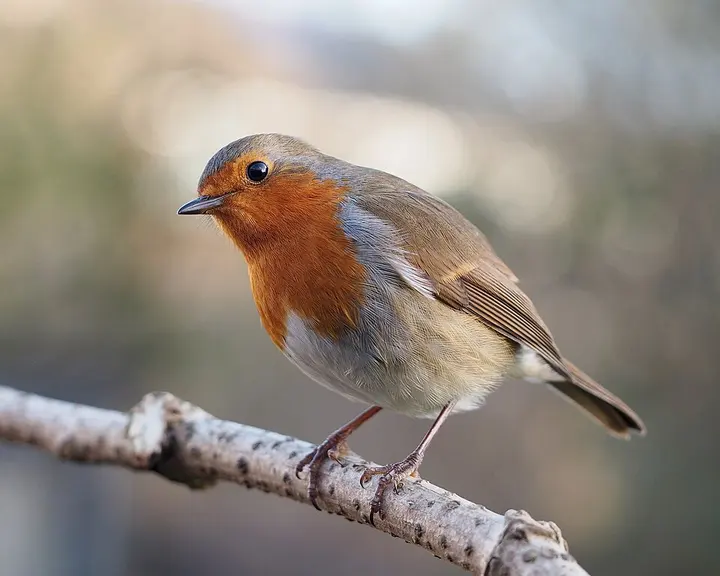
The European robin, known simply as the robin or robin redbreast in the British Isles, is a small insectivorous passerine bird belonging to the Old World flycatcher family Muscicapidae. It is found across Europe, as far east as Western Siberia, and as far south as North Africa. It is sedentary in the west and south of its range, and migratory in the north and east of its range where winters are harsher.
It is 12.5–14.0 cm (4.9–5.5 in) in length. The male and female are identical in plumage, with an orange-toned red breast and face lined with grey, brown upper-parts and a whitish belly. Juveniles are distinct, being freckled brown all over and lacking the red breast. First-winter immatures resemble the adults, except they have more obvious yellow-brown tips to the wing covert feathers, which are inconspicuous or absent in adults.
Appearance
The adult European robin is 12.5–14.0 cm (4.9–5.5 in) long and weighs 16–22 g (0.56–0.78 oz), with a wingspan of 20–22 cm (8–8.5 in). The male and female bear similar plumage: an orange breast and face (more strongly coloured in the otherwise similar British subspecies E. r. melophilus), lined by a bluish grey on the sides of the neck and chest. The upperparts are brownish, or olive-tinged in British birds, and the belly whitish, while the legs and feet are brown.
Behaviour
The robin is diurnal, although it has been reported to hunt insects on moonlit nights or near artificial light. Well known to British and Irish gardeners, the robin is relatively unafraid of people and is drawn to human activities involving digging, such as gardening, in order to look for earthworms and other food that has been freshly turned up.
Habitat
The robin is found in Eurasia, from Western Siberia in the east to Algeria in the south, and on Atlantic islands as far west as the Central Group of the Azores and Madeira. It is a vagrant in Iceland. In the southeast, its range extends to Iran and the Caucasus mountain range. Irish and British robins are largely resident but a small minority, usually females, migrate to southern Europe during the winter, with some going as far as Spain.
Life cycle
Robins can build nests in a variety of places. In fact, they will consider anything that offers some shelter, such as a depression or a hole. As well as crevices and sheltered banks, they may also use pieces of machinery, barbecues, bicycle handlebars, the bristles of upturned brooms, discarded kettles, watering cans, flower pots and hats.
Where the European robin lives
Recorded in Sweden, United Kingdom, France, Spain, Netherlands, Germany, Finland, Norway, Denmark, Poland, Belgium and Portugal (Europe).
Most records fall in Skåne, Stockholm, Kalmar, Noord-Holland, Västra Götaland and Uusimaa.
See the European robin’s range on the globe
Conservation status
Least concern (LC). Not at risk: it is doing well in the wild. Categories are the IUCN Red List as republished by GBIF.
Sources
The range is a density of 11,016,914 georeferenced GBIF records, shown on the continents where it is mainly recorded, not an expert-drawn map. Description from Wikipedia.