Animals / Mammal
European rabbit
Oryctolagus cuniculus · Leporidae
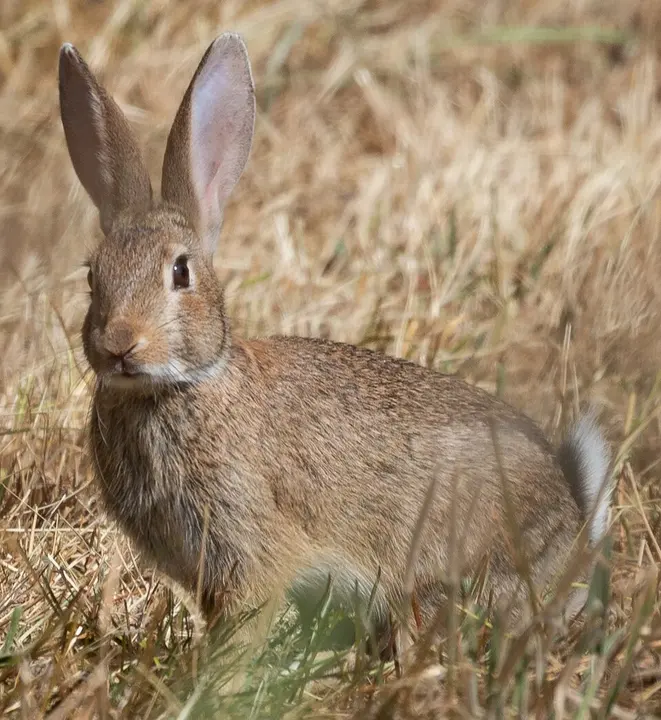
The European rabbit or coney is a species of rabbit native to the Iberian Peninsula and southwestern France. It has been introduced to hundreds of locations around the world. Wild and domesticated European rabbits around the world can vary widely in size, shape, and colour.
The average adult European rabbit is smaller than the European hare, though size and weight vary with habitat and diet. European rabbits prefer grassland habitats and are herbivorous, mainly feeding on grasses and leaves, though they may supplement their diet with berries, tree bark, and field crops such as maize. They are prey to a variety of predators, including birds of prey, weasels, cats, and canids. The European rabbit's main defence against predators is to run and hide, using vegetation and its own burrows for cover. It is well known for digging networks of burrows, called warrens, where it spends most of its time when not feeding. The European rabbit lives in social groups centred around territorial females.
Appearance
Adult European rabbits typically range from 36 to 38 centimetres (14 to 15 inches) in length and weigh 1.5 to 3 kilograms (3.3 to 6.6 pounds). The tail is 6.5 to 7 cm (2.6 to 2.8 in) long, and the hind foot measures 8 to 8.9 cm (3.1 to 3.5 in) in length. The ears are 7 to 8 cm (2.8 to 3.1 in) long. The European rabbit is smaller than the European hare and mountain hare, has proportionately shorter legs and lacks black ear tips.
Behaviour
The European rabbit is a relatively quiet animal, though it has at least two vocalizations. The best-known is a high treble scream or squeal. This distress call has been likened to the cry of a piglet, and is uttered when in extreme distress, such as being caught by a predator or trap. During the spring, bucks express contentment by emitting grunting sounds when approaching other rabbits. These grunts are similar to shrill hiccups, and are emitted with the mouth closed.
Diet
The European rabbit eats a wide variety of herbage, especially grasses. It favours young leaves and shoots from nutritious species, particularly fescues. In cultivated areas, the rabbit's diet expands to various crops, including sugar beet, hay, and cereals. Winter wheat is preferred over maize and dicotyledons.
Habitat
The European rabbit's ideal habitat consists of short grasslands with secure refuge (such as burrows, boulders, hedgerows, scrub, and woodland) near feeding areas. The size and distribution of its burrow systems depend on the type of soil present. In areas with loose soil, it selects sites with supporting structures, such as tree roots or shrubs, to prevent burrow collapse.
Where the European rabbit lives
Recorded in France and Spain (Europe, Oceania and South America).
Introduced, not native, in United Kingdom, Netherlands, Ashmore and Cartier Is., Belgium, Chile and Germany.
Most records fall in New South Wales, Antwerp, South Australia, East Flanders, Noord-Brabant and Zuid-Holland.
See the European rabbit’s range on the globe
Conservation status
Endangered (EN). In danger of dying out in the wild. Categories are the IUCN Red List as republished by GBIF.
Sources
The range is a density of 726,413 georeferenced GBIF records, shown on the continents where it is mainly recorded, not an expert-drawn map. Description from Wikipedia.