Animals / Insect
European mantis
Mantis religiosa · Mantidae
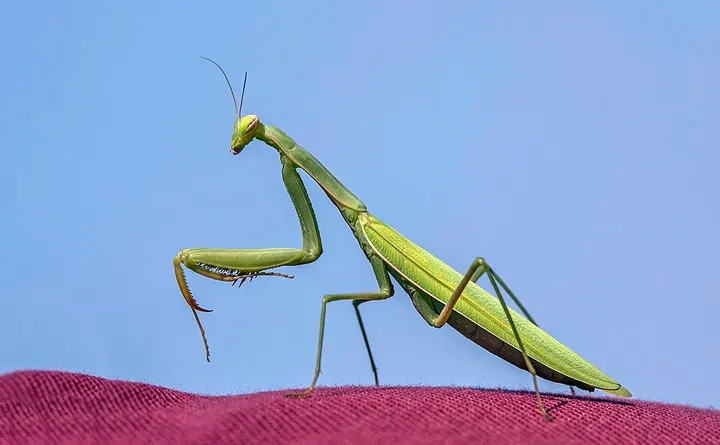
The European mantis is a large hemimetabolic insect in the family Mantidae, which is the largest family of the order Mantodea (mantises). Their common name praying mantis is derived from the distinctive posture of the first pair of legs, which can be observed when the mantis is in repose, resembling a praying position. Both males and females have elongated bodies with two pairs of wings.
The most striking features that the species (and all mantodeans) have are a very mobile, triangular head with large compound eyes and their first pair of legs (the 'raptorial legs'), which is highly modified for the efficient capture and restraint of fast-moving or flying prey. In Germany, M. religiosa is listed as Gefährdet [endangered] on the German Red List on the basis of an assessment from 1998. It is not supposed to be caught or held as a pet. At a global level, it is assessed by the IUCN as least concern.
Appearance
Though females of M. religiosa are usually larger and heavier than males (6-8 cm versus 5-7 cm), the antennae and the eyes of male animals outsize those of the females. Along with the forward-directed, compound eyes, simple eyes also are found on the head. These three dorsal ocelli are also more pronounced in males than in females. Males are often found to be more active and agile, whereas females are physically more powerful.
Diet
M. religiosa is a carnivorous ambush predator that actively scans its environment and feeds on most insects that are not too large to be captured by rapid extension of its raptorial legs. Only living and moving prey is captured and consumed immediately using their powerful mandibles. Grasshoppers seem to be rather popular, probably because of their type of movement (flying or leaping), but crickets and cockroaches are also frequently preyed upon.
Habitat
M. religiosa can be found throughout Europe, Asia, and Africa, as well as North America, where it is considered introduced. Two confirmed stable populations are in Germany: one in Rhineland-Palatinate and one in Baden-Württemberg. In the last years, more reports have been made of the distribution of the animals in Northern Europe (Latvia, Estonia), as well.
Life cycle
The sexual behavior of praying mantis in general is curious, so has received interest from scientists over the last century. The differences between the various species are well known. Only a few days after the final moult into adults, the animals begin to show interest in the opposite sex; this point is marked as the achievement of sexual maturity. Males have been observed to be most attracted to females during the middle of the day when the temperature is hottest.
Where the European mantis lives
Recorded in France, Germany, Spain, Switzerland, Italy, Austria, Russia, Portugal and Croatia (Europe and North America).
Introduced, not native, in United States of America and Canada.
Most records fall in Rheinland-Pfalz, California, Ontario, Brandenburg, Sachsen-Anhalt and Hessen.
See the European mantis’s range on the globe
Conservation status
Least concern (LC). Not at risk: it is doing well in the wild. Categories are the IUCN Red List as republished by GBIF.
Sources
The range is a density of 147,529 georeferenced GBIF records, shown on the continents where it is mainly recorded, not an expert-drawn map. Description from Wikipedia.