Animals / Bird
European herring gull
Larus argentatus · Laridae
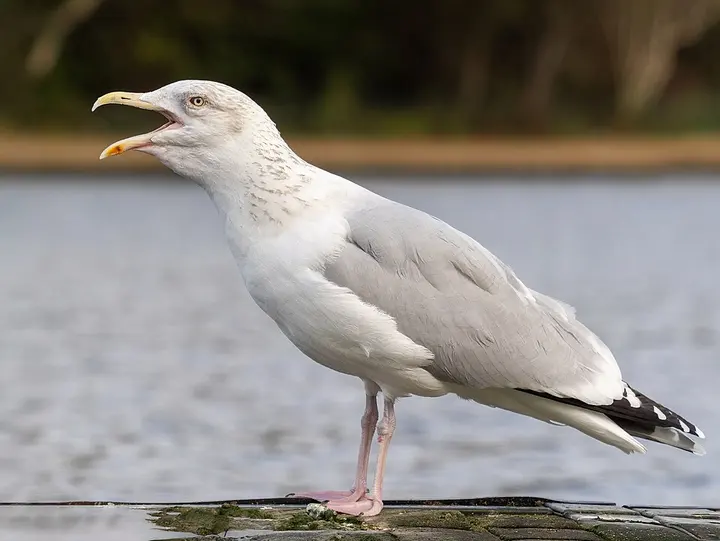
The European herring gull or simply herring gull is a large gull, up to 66 cm (26 in) long. It breeds throughout the northern and western coasts of Europe. Some European herring gulls, especially those resident in colder areas, migrate farther south in winter, but many are permanent residents, such as in Ireland, Britain, Iceland, or on the North Sea shores.
They have a varied diet, including fish, crustaceans, as well as some plants, and are also scavengers, consuming carrion and food left by or stolen from humans.
Appearance
The male European herring gull is 60–67 cm (24–26 in) long and weighs 1,050–1,525 g (2.315–3.362 lb), while the female is 55–62 cm (22–24 in) and weighs 710–1,100 g (1.57–2.43 lb). The wingspan can range from 125 to 155 cm (49 to 61 in). Among standard measurements, the wing chord is 38 to 48 cm (15 to 19 in), the bill is 4.4 to 6.5 cm (1.7 to 2.6 in) and the tarsus is 5.3 to 7.5 cm (2.1 to 3.0 in).
Behaviour
European herring gull flocks have a loose pecking order, based on size, aggressiveness, and physical strength. Adult males are usually dominant over females and juveniles in feeding and boundary disputes, while adult females are typically dominant when selecting their nesting sites.
Diet
These are omnivores and opportunists like most Larus gulls, and scavenge from garbage dumps, landfill sites, and sewage outflows, with refuse comprising up to half of the bird's diet. It also steals the eggs and young of other birds (including those of other gulls), as well as seeking suitable small prey in fields, on the coast or in urban areas, or robbing plovers or lapwings of their catches.
Habitat
Herring gulls breed in much of north-western Europe, including Iceland, the United Kingdom, Ireland and France. Since 2009, herring gulls in the United Kingdom have been on the red list of birds of conservation concern. They have been recorded from all the coasts of Europe including the Mediterranean and occasionally inland. Vagrants have been recorded in Israel, Cyprus and Turkey.
Where the European herring gull lives
Recorded in Belgium, United Kingdom, Netherlands, France, Sweden, Norway, Denmark, Finland and Germany (Europe).
Most records fall in West Flanders, Pas-de-Calais, Noord-Holland, Zeeland, Syddanmark and Hovedstaden.
See the European herring gull’s range on the globe
Conservation status
Least concern (LC). Not at risk: it is doing well in the wild. Categories are the IUCN Red List as republished by GBIF.
Sources
The range is a density of 7,733,278 georeferenced GBIF records, shown on the continents where it is mainly recorded, not an expert-drawn map. Description from Wikipedia.