Animals / Mammal
European hedgehog
Erinaceus europaeus · Erinaceidae
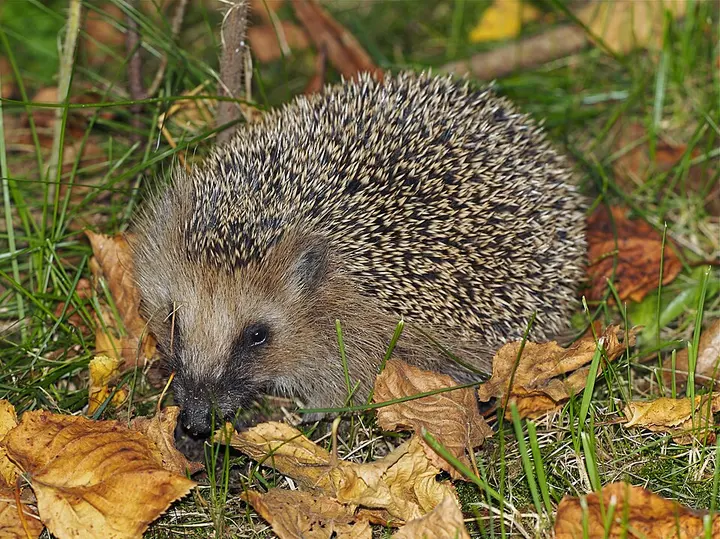
The European hedgehog, also known as the West European hedgehog or common hedgehog, is a hedgehog species native to Europe from Iberia and Italy northwards into Scandinavia and westwards into Ireland. It is a generally common and widely distributed species that can survive across a wide range of habitat types. It is a well-known species, and a favourite in European gardens, both for its endearing appearance and its preference for eating a range of garden pests.
While populations are currently stable across much of its range, it is declining severely in Great Britain, where it is now Red Listed, meaning that it is considered to be at risk of local extinction. Outside its native range the species was introduced to New Zealand during the late nineteenth and early twentieth centuries.
Appearance
The European hedgehog has a generalised body structure with unspecialised limb girdles. It appears brownish with most of its body covered by up to 6000 brown and white spines. The length of head and body is ~160 mm (6 in) at weaning, increasing to 260 mm (10 in) or more in large adults. It has an extremely short tail as an almost vestigial feature, typically 20 to 30 mm (0.8 to 1.2 in). Weight increases from around 120 g (4 oz) at weaning to > 1100 g (40 oz) in adulthood.
Behaviour
The European hedgehog is largely nocturnal. It has a hesitant gait, frequently stopping to smell the air. Unlike the smaller, warmer-climate species, the European hedgehog may hibernate in the winter. However most wake at least once to move their nests.
Diet
The European hedgehog is an insectivore. Its diet consists largely of earthworms, as well as snails and slugs, beetles, ants, bees and wasps, earwigs, cockroaches, crickets and grasshoppers, butterflies and moths, and caterpillars and other insect larvae. Eggs of ground-nesting birds are also taken and carcasses may be foraged on. Hedgehogs may also eat lizards, snakes, frogs and small rodents. Plant matter appears to make up only a negligible part of the hedgehog's diet.
Habitat
The European hedgehog is native to Europe, with a global distribution extending from Ireland and the Iberian Peninsula eastwards through much of western to central Europe, and from southern Fennoscandia and the northern Baltic to north-west Russia. It is present also on Mediterranean islands (Corsica, Sardinia, Elba, Sicily), on most of the French Atlantic islands as well as on Irish and British islands (autochthonous and introduced).
Life cycle
The breeding season commences after hibernation. Pregnancies peak between May and July, though they have been recorded as late as September. Gestation is 31 to 35 days. The female alone raises the litter, which typically numbers between four and six, though the range is from two to ten. Studies have indicated that litter size may increase in more northern climes. The young are born blind with a covering of small spines.
Where the European hedgehog lives
Recorded in United Kingdom, Netherlands, Sweden, France, Switzerland and Germany (Europe).
Most records fall in Skåne, Hampshire, Zuid-Holland, Noord-Holland, Gelderland and Zürich.
See the European hedgehog’s range on the globe
Conservation status
Near threatened (NT). Not at risk yet, but could be soon. Categories are the IUCN Red List as republished by GBIF.
Sources
The range is a density of 906,796 georeferenced GBIF records, shown on the continents where it is mainly recorded, not an expert-drawn map. Description from Wikipedia.