Animals / Mammal
European bison
Bison bonasus · Bovidae
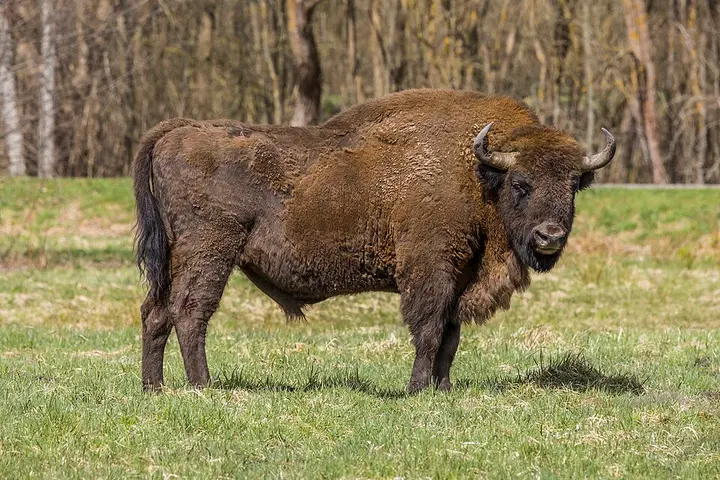
The European bison or the European wood bison, also known as the wisent, the zubr, or sometimes colloquially as the European buffalo, is a European species of bison. It is one of two extant species of bison, alongside the American bison. The European bison is the heaviest wild land animal in Europe, and individuals in the past may have been even larger than their modern-day descendants.
During late antiquity and the Middle Ages, bison became extinct in most of Europe and Asia, surviving into the 20th century only in northern-central Europe and the northern Caucasus Mountains. During the early years of the 20th century, the remaining bison were hunted to extinction in the wild, with domestic bison later reintroduced into the wild. By the late 2010s, the species numbered several thousand and had been returned to the wild by captive breeding programmes. It is no longer in immediate danger of extinction, but remains absent from most of its historical range. It is not to be confused with the aurochs (Bos primigenius), the extinct ancestor of domestic cattle, with which it once co-existed. Besides humans, bison have few predators.
Appearance
The European bison is the heaviest surviving wild land animal in Europe.
Diet
European bison feed predominantly on grasses, sedges, and herbs, although they also browse on shoots, twigs, bark, and leaves from trees and shrubs; in summer, an adult male can consume 32 kg of food in a day. Mosses, horsetails, ferns, and fungi combined account for 0.1 to 0.7% of the rumen capacity, depending on the season.
Habitat
The largest European bison herds — of both captive and wild populations — are still located in Poland and Belarus, the majority of which can be found in the Białowieża Forest including the most numerous population of free-living European bison in the world with most of the animals living on the Polish side of the border. Poland remains the world's breeding centre for the wisent.
Life cycle
The rutting season occurs from August through to October. Bulls aged 4–6 years, though sexually mature, are prevented from mating by older bulls. Cows usually have a gestation period of 264 days, and typically give birth to one calf at a time. On average, male calves weigh 27.6 kg (60.8 lb) at birth, and females 24.4 kg (53.8 lb). Body size in males increases proportionately to the age of 6 years.
Where the European bison lives
Recorded in Poland, Netherlands, Russia, Belarus, Denmark and Germany (Europe).
Most records fall in Podlachian, Noord-Holland, Noord-Brabant, Vladimir, Gelderland and Zeeland.
See the European bison’s range on the globe
Conservation status
Near threatened (NT). Not at risk yet, but could be soon. Categories are the IUCN Red List as republished by GBIF.
Sources
The range is a density of 4,006 georeferenced GBIF records, shown on the continents where it is mainly recorded, not an expert-drawn map. Description from Wikipedia.