Animals / Mammal
European badger
Meles meles · Mustelidae
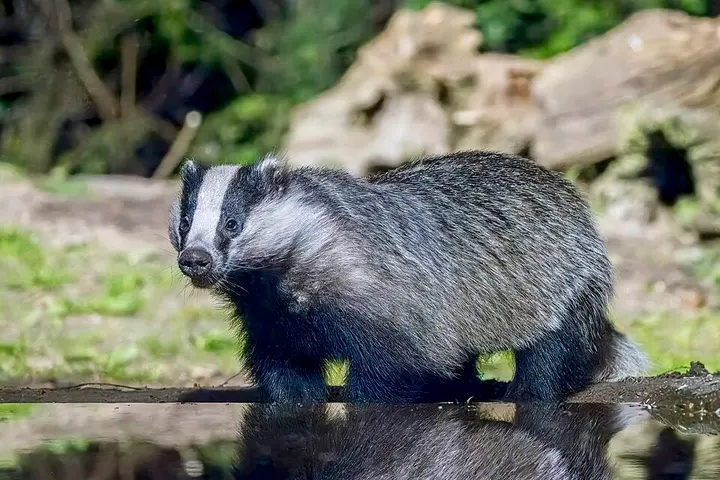
The European badger, also known as the Eurasian badger, is a species of badger in the family Mustelidae native to Europe and West Asia and parts of Central Asia. It is classified as least concern on the IUCN Red List due to its wide range and large, stable population size which is thought to be increasing in some regions. Several subspecies are recognised, with the nominate subspecies predominating in most of Europe.
In the UK it is the only extant species, and is simply known as the "badger". The European badger is a powerfully built animal with a small head, stocky body, small black eyes and short tail, and a coat of black, white, brown, and grey fur. Its weight varies, ranging from 7–13 kg (15–29 lb) in spring to 15–17 kg (33–37 lb) in autumn before the winter sleep period. It is nocturnal and social, living in burrows and sleeping during the day in one of several setts within its territory. These burrows have multiple chambers and entrances and comprise extensive systems of underground passages measuring 35–81 m (115–266 ft) in length. Several badger families use these setts for decades.
Appearance
European badgers are powerfully built animals with small heads, thick, short necks, stocky, wedge-shaped bodies and short tails. Their feet are either plantigrade or semi-digitigrade and short, with five toes on each foot. The limbs are short and massive, with bare lower surfaces on the feet. The claws are strong and elongated with an obtuse end to facilitate digging. The claws are not retractable, and the hind claws wear with age.
Behaviour
European badgers are the most sociable of all badger species, forming groups of six adults on average, though larger groups of up to 23 individuals have been recorded. Group size may be related to habitat composition. Under optimal conditions, badger territories can be as small as 30 ha (74 acres), but may be as large as 150 ha (370 acres) in marginal areas. Badger territories can be identified by the presence of communal latrines and well-worn paths.
Diet
European badgers are among the least carnivorous members of the Carnivora. They are highly adaptable and opportunistic omnivores whose diet encompasses a wide range of animals and plants. Their most important food source is earthworms, followed by large insects, carrion, cereals, fruit and small mammals, including rabbits, mice, rats, voles, shrews, moles and hedgehogs.
Habitat
The European badger is native to most of Europe. It is found in Albania, Armenia, Austria, Belarus, Belgium, Bosnia and Herzegovina, Bulgaria, Crete, Croatia, Czechia, Denmark, Estonia, Finland, France, Georgia, Germany, Great Britain, Greece, Hungary, Ireland, Italy, Latvia, Lithuania, Luxembourg, Macedonia, Moldova, Montenegro, the Netherlands, Norway, Poland, Portugal, Romania, Russia, Serbia, Slovakia, Slovenia, Spain, Sweden, Switzerland and Ukraine.
Where the European badger lives
Recorded in Switzerland, France, United Kingdom, Netherlands, Spain, Luxembourg, Germany and Belgium (Europe).
Most records fall in Zürich, Vaud, Liege, Solothurn, Bern and Lucerne.
See the European badger’s range on the globe
Conservation status
Least concern (LC). Not at risk: it is doing well in the wild. Categories are the IUCN Red List as republished by GBIF.
Sources
The range is a density of 550,398 georeferenced GBIF records, shown on the continents where it is mainly recorded, not an expert-drawn map. Description from Wikipedia.