Animals / Bird
Eurasian magpie
Pica pica · Corvidae
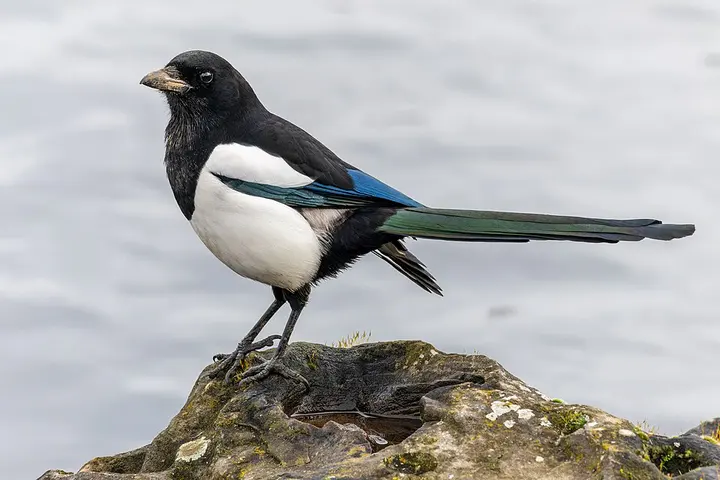
The Eurasian magpie or common magpie is a resident breeding bird throughout the northern part of the Eurasian continent. It is one of several birds in the crow family (corvids) that are designated as magpies, and it belongs to the Holarctic radiation of "monochrome" magpies. In Europe, the term "magpie" is used by English speakers as a synonym for the Eurasian magpie; the only other species of magpie in Europe being the Iberian magpie, which is restricted to the Iberian Peninsula.
Despite sharing a name and similar colouration, they are not closely related to the Australian magpie, which is an artamid, only sharing the same clade (Corvides). The Eurasian magpie is one of the most intelligent birds. The expansion of its nidopallium is approximately the same in its relative size as the brains of chimpanzees, gorillas, orangutans and humans. It is one of the few bird species known to pass the mirror test.
Appearance
The adult male of the nominate subspecies, P. p. pica, is 44–46 cm (17–18 in) in length, more than half of which is the tail. Its wingspan is 52–62 cm (20–24 in). The head, neck, breast and vent are glossy black with a metallic green and violet sheen; the belly and scapulars (shoulder feathers) are pure white; the wings are black glossed with green or purple, and the primaries have white inner webs, conspicuous when the wing is open.
Behaviour
Some magpies breed after their first year, while others remain in the non-breeding flocks and first breed in their second year. They are monogamous, and the pairs often remain together from one breeding season to the next. They generally occupy the same territory on successive years. Mating takes place in spring.
Diet
The magpie is omnivorous, eating young birds and eggs, small mammals, insects, scraps and carrion, acorns, grain, and other vegetable substances.
Habitat
The range of the magpie extends across temperate Eurasia from Portugal, Spain and Ireland in the west to the Kamchatka Peninsula in the east. Magpies prefer open countryside with scattered trees and magpies are normally absent from treeless areas and dense forests. They sometimes breed at high densities in suburban areas such as parks and gardens. They can often be found close to city centres. In Sweden, magpies are exclusively associated with human settlements.
Life cycle
Some magpies breed after their first year, while others remain in the non-breeding flocks and first breed in their second year. They are monogamous, and the pairs often remain together from one breeding season to the next. They generally occupy the same territory on successive years. Mating takes place in spring.
Where the Eurasian magpie lives
Recorded in United Kingdom, France, Sweden, Netherlands, Spain, Norway, Germany, Denmark, Finland, Belgium and Italy (Europe).
Most records fall in Noord-Holland, Västra Götaland, Stockholm, Zuid-Holland, Hovedstaden and Noord-Brabant.
See the Eurasian magpie’s range on the globe
Conservation status
Least concern (LC). Not at risk: it is doing well in the wild. Categories are the IUCN Red List as republished by GBIF.
Sources
The range is a density of 8,245,758 georeferenced GBIF records, shown on the continents where it is mainly recorded, not an expert-drawn map. Description from Wikipedia.