Animals / Mammal
Eurasian lynx
Lynx lynx · Felidae
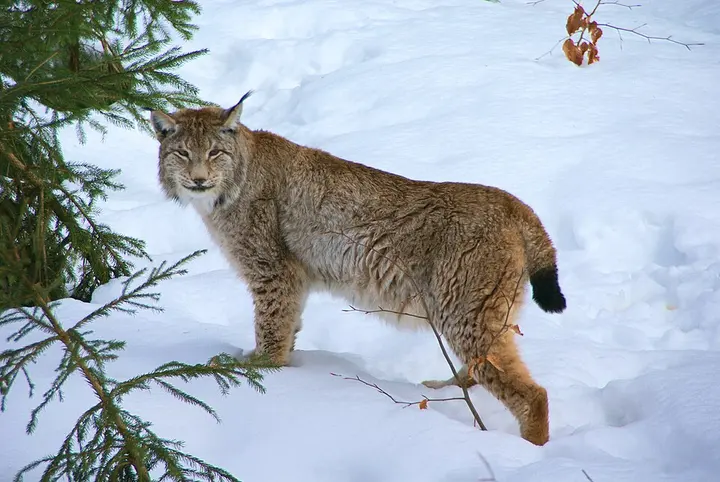
The Eurasian lynx is one of the four extant species within the medium-sized wild cat genus Lynx. It is widely distributed from Northern, Central and Eastern Europe to Central Asia and Siberia, the Tibetan Plateau and the Himalayas. It inhabits temperate and boreal forests up to an elevation of 5,500 m (18,000 ft).
Despite its wide distribution, it is threatened by habitat loss and fragmentation, poaching and depletion of prey.
Appearance
The Eurasian lynx has a relatively short, reddish or brown coat that is marked with black spots; their number and pattern are highly variable. The underparts, neck and chin are whitish. The fur is more brightly coloured with more numerous spots in animals living at the southern end of its range. In winter, it is much thicker and varies from silver-grey to greyish brown. Some animals have dark brown stripes on the forehead and back.
Behaviour
Although they may hunt during the day when food is scarce, the Eurasian lynx is mainly nocturnal or crepuscular, and spends the day sleeping in dense thickets or other places of concealment. It lives solitarily as an adult. The hunting area of Eurasian lynx can be anything from 20 to 450 km2 (7.7 to 173.7 sq mi), depending on the local availability of prey.
Diet
The Eurasian lynx is an ambush predator but also hunts by stalking, sneaking and jumping on prey using both vision and hearing. When snow conditions make this harder, it may be forced to switch to larger prey. It often climbs onto high rocks or fallen trees to scan the surrounding area. It is a powerful predator that has killed adult deer weighing at least 150 kg (330 lb). Eurasian lynx in Europe prey largely on small to fairly large sized mammals and birds.
Habitat
The Eurasian lynx inhabits rugged country providing plenty of hideouts and stalking opportunities. Depending on the locality, this may include rocky-steppe, mixed forest-steppe, boreal forest, and montane forest ecosystems. In the more mountainous parts of its range, Eurasian lynx descends to the lowlands in winter, following prey species and avoiding deep snow.
Life cycle
The mating season of the Eurasian lynx lasts from January to April. The female typically comes into oestrus only once during this period, lasting from four to seven days. If the first litter is lost, a second period of oestrus is common. It does not appear to be able to control its reproductive behaviour based on prey availability. Gestation lasts from 67 to 74 days. Pregnant females construct dens in secluded locations, often protected by overhanging branches or tree roots.
Where the Eurasian lynx lives
Recorded in Switzerland, Norway, France, Sweden, Finland and Estonia (Europe).
Most records fall in Vaud, Bern, Nordland, Nord-Trøndelag, Fribourg and Telemark.
See the Eurasian lynx’s range on the globe
Conservation status
Least concern (LC). Not at risk: it is doing well in the wild. Categories are the IUCN Red List as republished by GBIF.
Sources
The range is a density of 89,825 georeferenced GBIF records, shown on the continents where it is mainly recorded, not an expert-drawn map. Description from Wikipedia.