Animals / Bird
Eurasian collared dove
Streptopelia decaocto · Columbidae
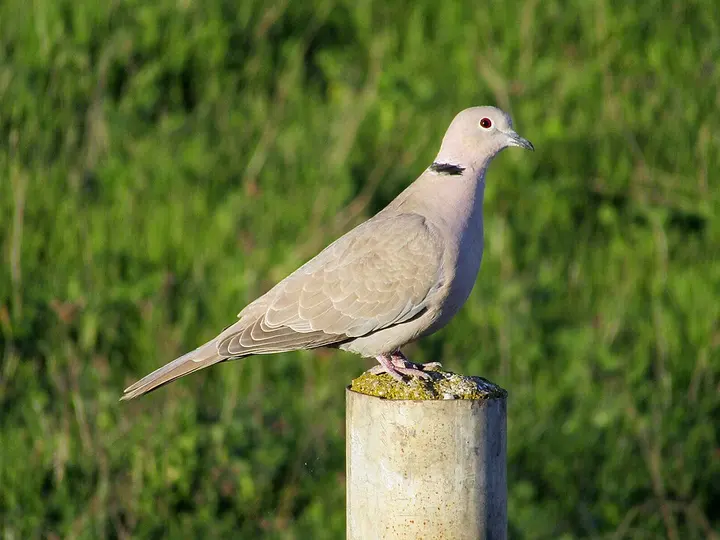
The Eurasian collared dove, often called the collared dove, is a dove species from the genus Streptopelia. It is grey-buff to pinkish-grey, and has a black half-collar edged with white on its nape, alluding to the name. It is native to Europe, Asia, and North Africa.
It has also been introduced to Japan, North and Central America, and select Caribbean islands.
Appearance
It is a medium-sized dove, with an average length of 32 cm (13 in) from tip of beak to tip of tail, a wingspan of 47–55 cm (19–22 in) and a weight of 125–240 g (4.4–8.5 oz). It is grey-buff to pinkish-grey, slightly darker above than below, and with a blue-grey underwing patch. The tail feathers are grey-buff above, and dark grey and tipped white below; the outer tail feathers are also tipped whitish above. It has a black half-collar edged with white on its nape.
Behaviour
Eurasian collared doves typically breed close to human habitation wherever food resources are abundant and trees are available for nesting; almost all nests are within 1 km (0.62 mi) of inhabited buildings. The female lays two white eggs in a stick nest, which she incubates during the night and the male incubates during the day. Incubation lasts between 14 and 18 days, with the young fledging after 15 to 19 days.
Habitat
The Eurasian collared dove is resident in Europe from Scandinavia and central Europe and eastwards to the Levant, the Arabian Peninsula and Central Asia. It is strongly dispersive. Over the last century, it has travelled far beyond its native range to colonise colder countries, becoming a permanent resident in several of them. Its original range at the end of the 19th century was Asia, from eastern Turkey to southern China, and south through India to Sri Lanka.
Life cycle
Eurasian collared doves typically breed close to human habitation wherever food resources are abundant and trees are available for nesting; almost all nests are within 1 km (0.62 mi) of inhabited buildings. The female lays two white eggs in a stick nest, which she incubates during the night and the male incubates during the day. Incubation lasts between 14 and 18 days, with the young fledging after 15 to 19 days.
Where the Eurasian collared dove lives
Recorded in France, Spain, United Kingdom, Netherlands, India, Portugal, Sweden, Germany, Belgium and Denmark (North America, Europe and Asia).
Introduced, not native, in United States of America, Canada and Mexico.
Most records fall in California, Colorado, Texas, Florida, Arizona and Oregon.
See the Eurasian collared dove’s range on the globe
Conservation status
Least concern (LC). Not at risk: it is doing well in the wild. Categories are the IUCN Red List as republished by GBIF.
Sources
The range is a density of 9,656,378 georeferenced GBIF records, shown on the continents where it is mainly recorded, not an expert-drawn map. Description from Wikipedia.